

Why School Disinfection Services Matter for Student and Staff Health
School disinfection services are professional cleaning programs that go beyond routine janitorial work to actively eliminate bacteria, viruses, and pathogens from school surfaces — keeping students healthy, reducing absenteeism, and creating safer learning environments.
What school disinfection services typically include:
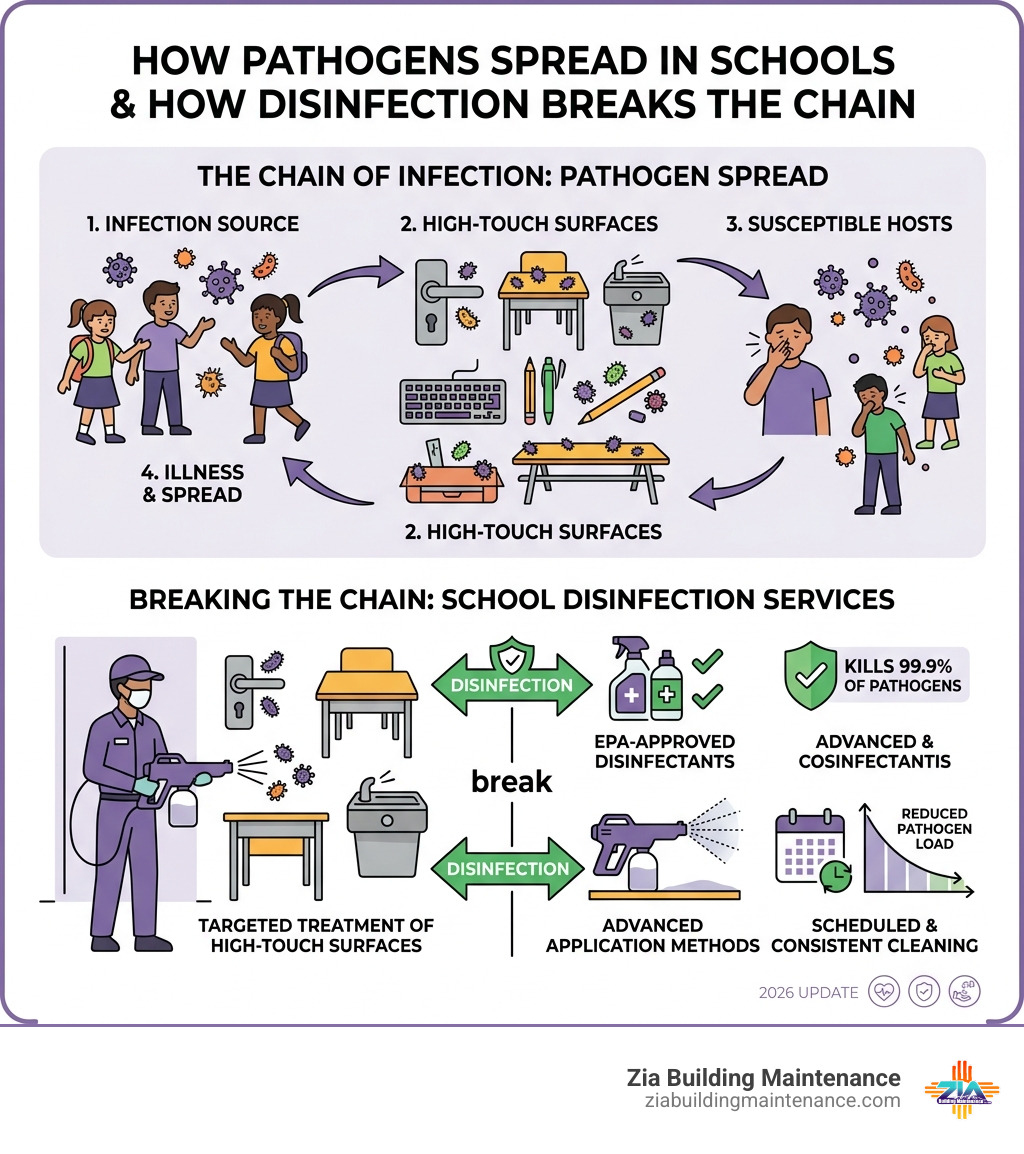
- Targeted treatment of high-touch surfaces (desks, door handles, cafeteria tables)
- EPA-approved disinfectants that kill 99.9% of bacteria and viruses
- Scheduled maintenance visits plus emergency outbreak response
- Advanced application methods like electrostatic spraying
- Air quality improvements through HVAC and filtration maintenance
- Customized plans for classrooms, gyms, restrooms, cafeterias, and more
Schools are some of the highest-traffic environments on the planet. Hundreds of students move through the same hallways, share the same supplies, and touch the same surfaces — every single day.
The numbers tell a clear story. According to a Washington Post-Schar School survey, 79% of parents are concerned that in-person learning could make their child or family members sick. A Gallup survey found that 75% of teachers are moderately or very concerned about exposure at the workplace. And perhaps most telling: 88% of students say unclean spaces cause distraction and disruption to their learning.
Standard cleaning removes visible dirt. But it doesn’t kill the pathogens behind flu outbreaks, norovirus, strep throat, or MRSA. That gap — between looking clean and being disinfected — is exactly where professional school disinfection services make the difference.
In April 2026, with health and safety expectations higher than ever, schools can’t afford to rely on surface-level solutions.
I’m Ashley Cordova, Vice President of Zia Building Maintenance, a family-owned janitorial company serving New Mexico since 1989 — and over the decades, our team has developed deep expertise in school disinfection services for educational facilities across Albuquerque and beyond. In this guide, I’ll walk you through exactly what effective school disinfection looks like, what technologies and methods work best, and how to build a program that protects every student and staff member in your building.
Quick School disinfection services definitions:
The Critical Role of Professional School Disinfection Services
When we walk into a school, we aren’t just looking at floors and windows; we are looking at a complex ecosystem where germs can travel from a doorknob to a desk to a student’s lunch tray in a matter of seconds. Professional school disinfection services act as a critical shield for this ecosystem.
The stakes are incredibly high. Beyond the personal health of students and faculty, there is the matter of community trust. When a school demonstrates a commitment to high-level disinfection, it reassures the 79% of parents who worry about their children bringing illnesses home. Moreover, professional services ensure that your facility remains in compliance with evolving health regulations, protecting the institution’s reputation and operational continuity.
Whether we are serving a small preschool in Rio Rancho or a sprawling collegiate facility in Albuquerque, the goal remains the same: a comprehensive disinfection solution that covers everything from K-12 classrooms to high-intensity athletic areas.
Impact on Student Health and Academic Performance
We often ask, What Is A Healthy School Environment Anyway? It is an environment where the primary focus is learning, not fighting off the latest “stomach bug” going around. Research shows that 88% of students agree that unclean spaces cause distraction and disruption. When a classroom smells of mildew or surfaces feel “sticky,” students lose focus.
By implementing consistent school disinfection services, we see a direct reduction in the spread of illnesses like influenza, strep throat, and norovirus. This leads to lower absenteeism rates for both students and staff. When teachers are healthy, they are in the classroom providing consistent instruction; when students are healthy, they aren’t missing critical lessons. It is a win-win for academic performance.
Building Safety Standards in Downtown Albuquerque
In high-density areas like Downtown Albuquerque, the concentration of people increases the risk of pathogen transmission. Schools in these urban centers face unique challenges, from higher foot traffic to older building infrastructures that may have limited ventilation.
Maintaining professional standards in these locations is about more than just checking a box; it’s about public health compliance. We work closely with the Top Public And Private Elementary Schools In Albuquerque to ensure their facility management plans meet the rigorous demands of a modern city. By adhering to professional standards, schools can provide a safe haven for students amidst the hustle and bustle of the city.
Cleaning vs. Sanitizing vs. Disinfecting: Understanding the Hierarchy
One of the most common points of confusion we encounter is the difference between cleaning, sanitizing, and disinfecting. To choose the right school disinfection services, you have to understand what each process actually achieves.
| Process | What It Does | Best Use Case |
|---|---|---|
| Cleaning | Removes visible dirt, dust, and debris using soap and water. | General floor care, windows, and dusting. |
| Sanitizing | Reduces the number of germs to a safe level as judged by public health standards. | Food contact surfaces like cafeteria trays. |
| Disinfecting | Uses chemicals to kill 99.9% of specific pathogens (viruses/bacteria) on surfaces. | High-touch areas during flu season or outbreaks. |
Standard cleaning is the foundation, but it isn’t enough to stop a virus. Sanitizing is great for the kitchen, but for the classroom, you need true disinfection. Our specialized school disinfection services utilize hospital-grade products that are designed to eliminate the toughest pathogens without leaving harmful residues behind.
Targeting High-Touch Surfaces in School Disinfection Services
If you want to stop an outbreak, you have to follow the hands. The Ultimate Guide To Cleaning And Disinfecting High Touch Surfaces highlights that certain areas are “germ magnets.”
In a school setting, these include:
- Cafeteria Trays and Tables: Where food and faces meet.
- Doorknobs and Push Plates: Touched by every single person entering a room.
- Computer Keyboards and Tablets: Shared supplies that harbor oils and microbes.
- Restroom Fixtures: High-moisture areas prone to bacterial growth.
By focusing our efforts on these specific zones, we prevent cross-contamination—the process where a student touches a contaminated doorknob and then touches their eyes or mouth, or shares a pencil with a friend.
The Importance of Dwell Time and EPA-Approved Methods
Disinfection isn’t a “spray and wipe” job. It requires a scientific concept called “dwell time.” This is the amount of time a disinfectant must remain wet on a surface to actually kill the pathogens listed on its label. If a cleaner sprays a desk and wipes it immediately, they may have only performed a “cleaning” action, leaving the viruses alive.
We exclusively use products from the EPA List N—the official list of disinfectants approved for use against SARS-CoV-2 and other difficult-to-kill viral pathogens. Whether we are dealing with seasonal bacterial strains or emerging viral threats, our methods are grounded in EPA-approved science to ensure your school is truly safe, not just “clean-looking.”
Advanced Technologies and Data-Driven Hygiene Monitoring
The year 2026 has brought incredible advancements to facility maintenance. We no longer have to guess if a surface is clean; we can use data to prove it. Advanced school disinfection services now incorporate monitoring systems that provide real-time tracking of hygiene levels.
By using these tools, we create a system of hygiene accountability. If a particular hallway shows higher-than-normal microbial counts, we can adjust our customized plans immediately. This proactive approach is a far cry from the reactive “wait until someone gets sick” methods of the past.
Electrostatic Spraying and HEPA Filtration
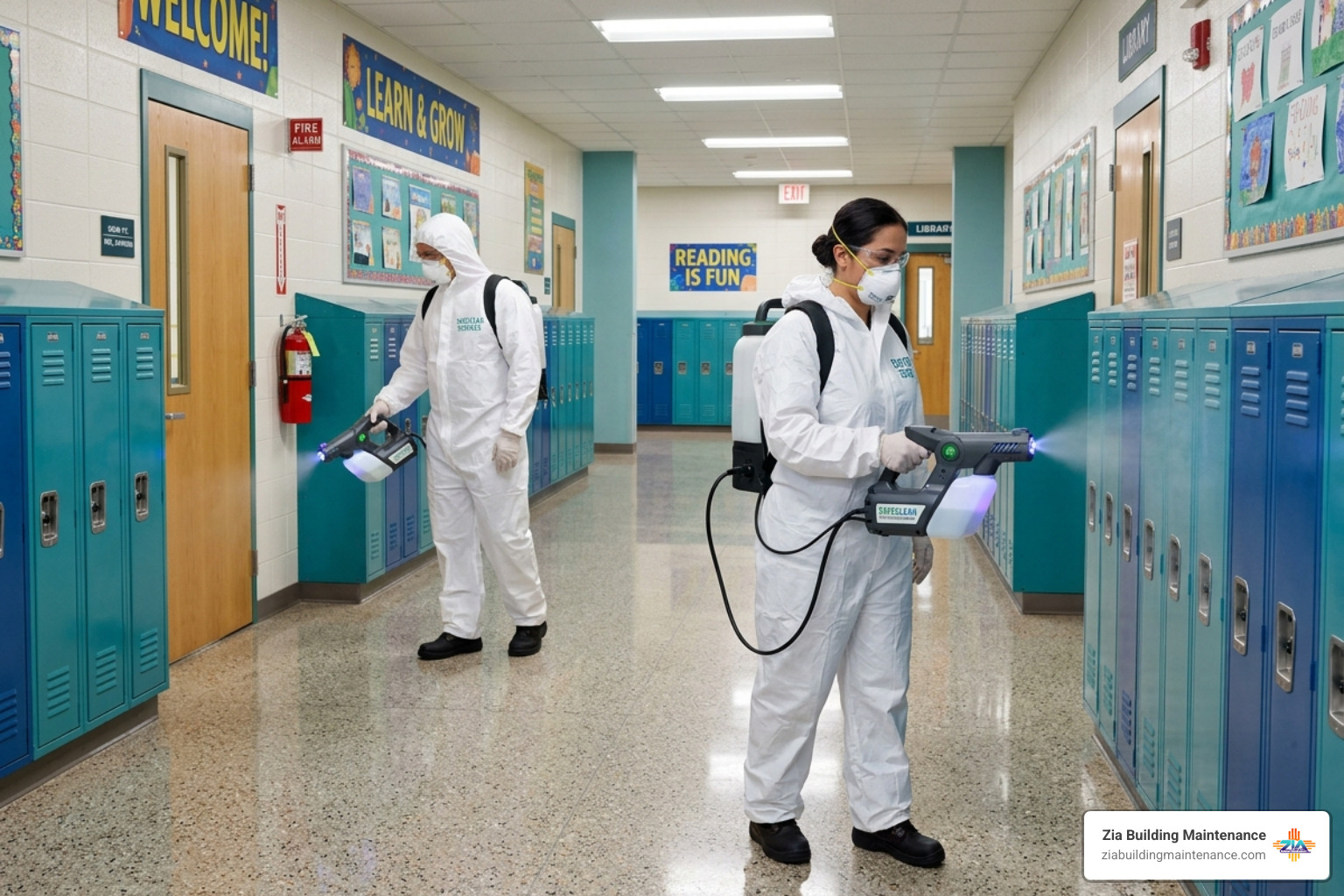
One of the most effective tools in our arsenal is electrostatic spraying. This technology gives disinfectant droplets a positive charge, allowing them to wrap around surfaces for 360-degree coverage. It reaches the undersides of desks, the back of chairs, and deep into the nooks and crannies of gym equipment that manual wiping would miss.
Furthermore, we utilize HEPA (High-Efficiency Particulate Air) vacuums. These aren’t your standard household vacuums; they are designed to capture 99% of airborne particles, including allergens and microscopic pathogens. This significantly improves indoor air quality, contributing to the overall well-being of everyone in the building.
Holistic Facility Management and Air Quality
A clean desk is only half the battle; the air students breathe is just as important. Comprehensive facility management includes HVAC maintenance and air scrubbing. By integrating UV-C technology into air handling systems, we can neutralize airborne viruses before they ever reach the classroom.
There is also a financial benefit to this holistic approach. Statistics show that education clients can see a 29% average reduction in energy use through optimized facility management, leading to an average savings of $1,100 per student. Efficient schools are healthy schools, and healthy schools are more affordable to run.
Strategic Scheduling for School Disinfection Services
Timing is everything when it comes to infection control. You wouldn’t treat a school the same way in July as you would in January.
We recommend a tiered approach to scheduling:
- Daily Maintenance: Routine cleaning and high-touch point disinfection.
- Weekly/Biweekly Disinfection: Deep treatment of common areas and classrooms, especially during peak illness season (November–March).
- Back-to-School Deep Cleans: A “reset” of the entire facility before students return from summer or winter breaks.
Seasonal Outbreaks and Emergency Response
When a “stomach bug” or a confirmed case of the flu hits a specific grade level, time is of the essence. Our school disinfection services include 24-hour emergency response capabilities. We can deploy teams to perform rapid-response disinfection within 24 to 48 hours of a confirmed case, focusing on the affected classrooms and communal zones to mitigate the outbreak before it spreads to the rest of the school. This is especially vital for protecting vulnerable populations, such as students with underlying health conditions or younger children in preschool settings.
Resource Management and Staff Training
Many schools struggle with resource limitations and consistency. Often, the internal custodial staff is overworked and may not have the specialized training required for deep disinfection protocols. We bridge this gap by providing professional training and support.
We also help schools implement “smart hygiene habits,” such as installing touchless fixtures in restrooms and providing disinfectant wipes for teachers. These small changes, combined with professional services, create a culture of cleanliness that is easier to maintain year-round.
Frequently Asked Questions about School Hygiene
How often should high-traffic areas be disinfected?
High-traffic zones like restrooms, cafeterias, and main entryways should receive daily cleaning and at least weekly disinfection. During peak illness season (November to March), we often increase this frequency to biweekly or even daily disinfection for high-risk touchpoints like doorknobs and water fountains.
What is the difference between sanitizing and disinfecting?
Sanitizing reduces bacteria on a surface to a safe level (usually required for food prep areas). Disinfecting uses stronger chemicals to actually kill both bacteria and viruses. In a school setting, sanitizing is for the cafeteria, but disinfecting is for the desks, restrooms, and nurse’s office.
Are the disinfection methods safe for students and staff?
Yes. We use EPA-registered, child-safe, and hypoallergenic formulas. When applied correctly—especially with technologies like electrostatic spraying—these products are non-toxic and safe for use in environments where children learn and play. We typically schedule deep disinfection after hours to allow for proper drying and ventilation before re-entry.
Conclusion
Creating a safe learning environment is a continuous journey, not a one-time task. At Zia Building Maintenance, we take pride in being a dependable, family-owned partner for schools in Albuquerque, Rio Rancho, and Bernalillo. Since 1989, our focus has been on the tiny details that make a massive difference in student health.
From the classrooms of Downtown Albuquerque to the athletic fields of the surrounding areas, we are committed to providing school disinfection services that build community trust and protect our next generation.