

TL;DR:
- A property maintenance cleaning contract is a legal agreement detailing specific cleaning tasks, service standards, and legal protections. Properly written contracts protect budgets, ensure compliance, and set clear expectations for performance and legal obligations. Regular reviews and task-level pricing help manage evolving facility needs and prevent disputes.
A property maintenance cleaning contract is a legally binding agreement that defines the exact cleaning tasks, service frequency, pricing structure, and legal obligations between a facility manager or property owner and a professional cleaning provider. Getting this document right is the single most effective way to protect your budget, maintain compliance, and hold your cleaning provider accountable. This guide covers the property maintenance cleaning contract explained in full, from core components and pricing models to legal clauses and performance management, so you can negotiate and manage your cleaning service agreement with confidence.
What are the essential components of a property maintenance cleaning contract?
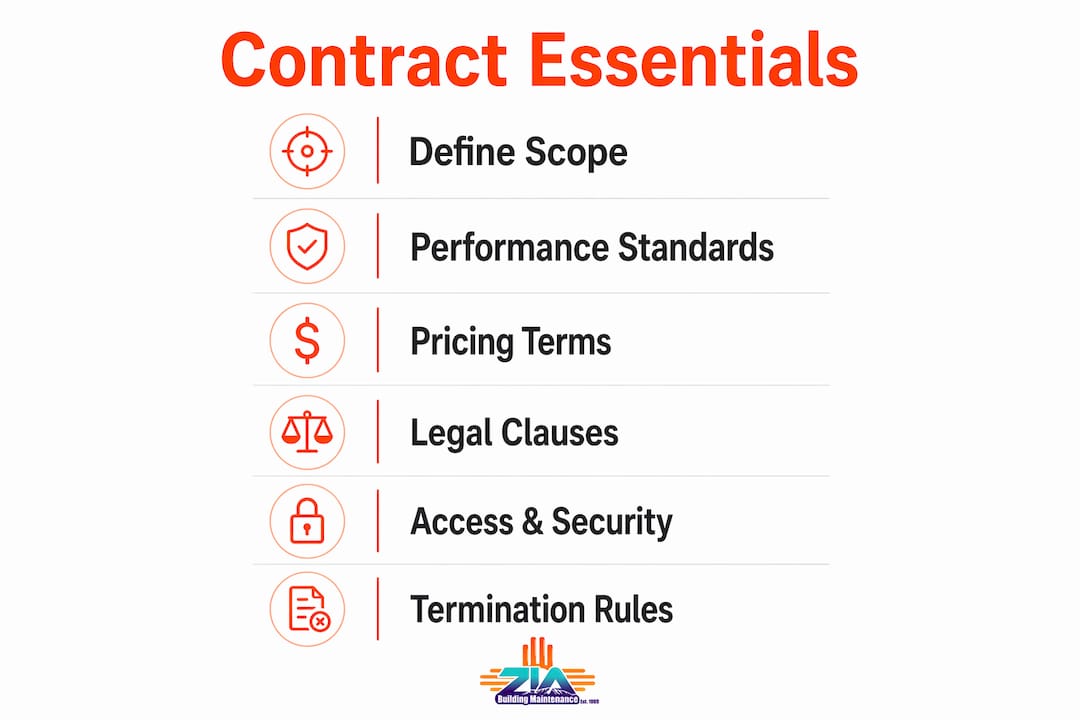
A well-structured cleaning service agreement removes ambiguity before work begins. Every contract should define the scope of work, service standards, pricing terms, and legal protections in clear, specific language.
Scope of work
The scope of work is the foundation of any commercial cleaning contract. It must list every task, the specific location where it applies, and how often it occurs. For example, restroom sanitization might be daily, while carpet extraction is quarterly. Generic or copied contract language is a leading cause of service failures. Explicitly naming excluded services, such as window washing, pressure cleaning, or pest control, prevents scope creep and budget disputes.

Service level agreements and performance standards
Contracts should include performance standards tied to specific areas, frequencies, audit processes, and quality benchmarks. Service Level Agreements, commonly called SLAs, set measurable expectations so both parties know what a passing inspection looks like. A contract without SLAs gives you no objective basis to dispute poor performance. Zia Building Maintenance builds audit checkpoints directly into its service plans to keep quality consistent across every visit.
Pricing, billing, and scheduling terms
Pricing models, billing cycles, and scheduling protocols all belong in the contract body, not in a separate verbal agreement. Specify whether billing is fixed monthly, per visit, or hourly. State the payment due date clearly, whether that is due on receipt, net 7, or net 30. Include scheduling windows and the process for requesting additional work.
Legal clauses
Every cleaning contract needs four legal protections: termination terms, liability coverage, insurance requirements, and incident reporting procedures. A standard termination clause includes 14 days’ written notice with outstanding balances due within 7 days after the contract ends. That window protects both the client and the provider from sudden financial exposure.
Pro Tip: Request a copy of your provider’s current certificate of insurance before signing. Confirm it lists general liability and workers’ compensation coverage, and keep the certificate on file for your own compliance records.
How do pricing and payment terms typically work in these contracts?
Pricing is where most facility managers make their biggest mistakes. Understanding how cleaning costs are built protects you from overpaying and from bids that look attractive but underdeliver.
Why square footage pricing misleads buyers
Labor costs represent 70%–80% of a property maintenance cleaning contract’s total expense. That single fact changes how you should evaluate every bid you receive. A flat square footage rate ignores the actual labor intensity of your space. A medical facility with strict disinfection protocols costs far more to clean per square foot than an open office floor, even if both spaces are the same size.
Pricing based on square footage alone is misleading. BSCAI guidance recommends building bids from task-level production rates, meaning the actual labor time required for each specific cleaning activity. Task-level pricing gives both facility managers and providers a clear, shared understanding of where every dollar goes.
Common billing models
- Fixed monthly price. One predictable invoice covers all scheduled services. Best for stable, recurring cleaning programs where the scope rarely changes.
- Per visit pricing. Each completed visit generates a separate charge. Works well for irregular schedules or facilities with variable foot traffic.
- Hourly rate. Labor time is billed directly. Useful for deep cleaning projects or one-time intensive services where scope is hard to predict in advance.
Cancellation and rescheduling policies
A 24-hour cancellation notice is the industry standard for recurring commercial cleaning. Cancellations with less than 24 hours’ notice typically incur the full service charge, because the provider has already committed labor and route time. Contracts often cap reschedules at two per month to prevent route disruption. Chronic rescheduling costs providers money and degrades service quality for every client on that route.
Price escalation clauses also belong in this section. A well-written contract specifies the conditions under which rates can increase, such as annual CPI adjustments or minimum wage changes, so neither party faces a surprise renegotiation.
What legal and compliance factors must facility managers consider?
Legal protections in a cleaning contract do more than satisfy attorneys. They define who is responsible when something goes wrong, and they set the rules for ending the relationship cleanly.
Insurance requirements
Insurance clauses typically cover general liability and workers’ compensation, but the contract should reference current coverage rather than listing fixed dollar amounts. Fixed amounts become outdated as policies renew and limits change. Referencing current coverage keeps the contract accurate without requiring an amendment every year.
Key insurance considerations to address in your contract:
- General liability coverage for property damage caused by cleaning staff
- Workers’ compensation coverage protecting you from claims if a cleaner is injured on your property
- Bonding requirements if staff will have access to secure areas or sensitive equipment
- Proof of coverage renewal, with notification requirements if a policy lapses
Access, security, and wasted visits
Contracts must define procedures for denied access, including fee charges for wasted visits and clear security responsibilities. If a cleaning crew arrives and cannot enter the building, someone pays for that time. Your contract should state who holds keys, who manages alarm codes, and what happens if access is denied. Without this language, you face disputes every time a scheduling conflict blocks entry.
Pro Tip: Include a named contact for after-hours access issues in the contract itself. A single point of contact for security incidents prevents delays and reduces the chance of a wasted visit charge.
Termination, liability, and dispute resolution
Termination terms should specify the notice period, the method of notice (written, email, or certified mail), and the timeline for settling any outstanding balance. Liability clauses should address theft, accidental damage, and incident reporting timelines. A dispute resolution clause, whether that means mediation or a specific jurisdiction for legal action, prevents small disagreements from escalating into costly litigation. Schedule a contract review at least once per year to keep terms aligned with your current facility needs.
How to tailor and manage cleaning contracts for evolving facility needs?
A cleaning contract is not a static document. Facilities change, staffing shifts, and service needs grow. Your contract must have built-in mechanisms to handle those changes without triggering a full renegotiation.
Defining exclusions and change orders
Explicitly stating exclusions prevents the most common source of budget disputes: scope creep. If window washing, exterior pressure cleaning, or biohazard cleanup are not in the contract, they are not included. Any additional work should require a written change order with a quoted price before the work begins. This protects both parties and keeps your budget predictable.
A commercial cleaning contract checklist helps facility managers confirm every exclusion and addition is documented before signing.
Performance audits and quality benchmarks
Regular inspections are the only reliable way to verify that your cleaning service agreement is being fulfilled. Schedule formal audits quarterly at minimum, with informal walkthroughs monthly. Document findings in writing and share them with your provider. A commercial property cleaning audit process gives you objective data to support contract discussions and, if needed, termination decisions.
Key elements of an effective performance management system:
- Written inspection reports with area-specific scores
- A defined threshold score that triggers a corrective action plan
- A response timeline for the provider to address deficiencies
- A record of all communications about performance issues
Staffing, supervision, and communication protocols
Your contract should specify whether the provider assigns a dedicated supervisor to your account. Management continuity matters. Frequent staff turnover without supervision leads to inconsistent results. Define the communication channel for routine updates, the escalation path for complaints, and the expected response time for urgent issues. Facilities with specialized needs, such as medical offices or schools, benefit from providers who assign trained, consistent teams rather than rotating general labor.
For facilities with floor care requirements, the contract should separately address surface-specific protocols to avoid damage from incorrect products or methods.
Key takeaways
A property maintenance cleaning contract protects your facility, your budget, and your working relationship with your provider when it is written with specificity, clear legal terms, and measurable performance standards.
| Point | Details |
|---|---|
| Labor drives cost | Labor represents 70%–80% of cleaning contract costs; use task-level pricing, not square footage rates. |
| SLAs set accountability | Include Service Level Agreements with audit scores and inspection schedules to measure provider performance. |
| Legal clauses prevent disputes | Termination, liability, insurance, and access protocols must be explicit to protect both parties. |
| Exclusions prevent scope creep | Name every excluded service in writing; require change orders for any work outside the original scope. |
| Cancellation terms protect revenue | A 24-hour notice standard with full-charge penalties keeps scheduling predictable for both sides. |
What I’ve learned from years of watching contracts fail
The most expensive cleaning contracts I have seen were not the ones with the highest rates. They were the ones written on generic templates where nobody defined what “clean” actually meant for that specific building.
Facility managers often focus on the monthly price and skip the scope detail. That is exactly backwards. A contract that specifies task-level pricing, names every excluded service, and ties payment to audit scores gives you far more control than a low flat rate with vague language. When a dispute arises, and it will, the only thing that matters is what the contract says.
Access and security clauses are the section I see skipped most often. A cleaning crew that cannot enter your building still costs you money if your contract does not address wasted visits. I have watched facilities pay for dozens of missed visits because nobody wrote down who holds the key or what happens when the alarm code changes. That is a fixable problem, and it costs nothing to fix at the contract stage.
The best vendor relationships I have observed share one trait: both sides review the contract together at least once a year. Facilities change. A contract written for 10,000 square feet of open office space does not fit the same building after a renovation adds server rooms and medical storage. Annual reviews keep the agreement current and signal to your provider that you are paying attention.
— Ashley
Trusted cleaning solutions for your property
Zia Building Maintenance has served commercial properties in Albuquerque since 1989, building customized cleaning plans for offices, medical facilities, and schools. Every plan starts with a detailed scope review so your contract reflects your actual facility needs, not a generic template.
Zia Building Maintenance offers professional office cleaning with flexible pricing models, performance audits, and dedicated account management. Whether you need a straightforward recurring program or a specialized compliance-ready plan, the team works with you to define scope, set measurable standards, and deliver consistent results. Request an estimate and get a cleaning plan built around your property’s specific requirements.
FAQ
What is a property maintenance cleaning contract?
A property maintenance cleaning contract is a legally binding agreement between a property owner or facility manager and a cleaning provider. It defines the scope of work, service frequency, pricing, legal obligations, and performance standards.
How should cleaning contract pricing be structured?
Pricing should be built from task-level production rates rather than flat square footage fees. Labor represents 70%–80% of total cleaning costs, so task-based pricing reflects actual service complexity more accurately.
What insurance should a cleaning contract require?
Contracts should require general liability and workers’ compensation coverage at minimum. Reference current coverage rather than fixed dollar amounts so the contract stays accurate as policies renew.
What happens if a cleaning crew is denied access?
The contract should define a wasted visit fee and specify who holds keys and manages alarm codes. Clear access protocols prevent disputes and reduce unexpected charges for both parties.
How often should a cleaning contract be reviewed?
Review your cleaning service agreement at least once per year. Facility changes, staffing shifts, and scope expansions all require contract updates to keep terms accurate and enforceable.