
TL;DR:
- Janitorial service pricing is based on models such as per square foot, hourly rate, or flat rate contracts to suit different facility needs. Facility type, cleaning frequency, and service complexity significantly influence costs, especially for specialized services like medical sanitation or deep cleaning. Accurate cost estimation relies on understanding labor, supplies, and overhead components, with transparent agreements reducing risks and improving service consistency.
Janitorial service pricing structure is defined as the framework a cleaning provider uses to calculate contract costs, based on square footage, labor hours, or a fixed recurring fee. Business managers who understand this framework can compare proposals accurately, avoid underbid contracts that signal poor quality, and build realistic facility budgets. The three primary models are per square foot, hourly rate, and flat rate contracts. Each model suits different facility types, cleaning frequencies, and service complexities. Knowing which model fits your situation is the first step toward a contract that delivers consistent, professional results.
What is janitorial service pricing structure and how does each model work?
Commercial cleaning pricing relies on three core models, and most providers use at least one of them as the foundation for every bid.
1. Per square foot pricing
Per square foot is the most common model for recurring janitorial contracts. Standard recurring office services typically range from $0.07 to $0.25 per square foot per month. That range is wide because it reflects differences in cleaning frequency, task scope, and local labor costs. A 10,000 square foot office building at $0.12 per square foot costs $1,200 per month. This model works well when the scope of work is predictable and consistent from visit to visit.
2. Hourly rate pricing
Hourly pricing applies best to one-time jobs, post-construction cleanups, or irregular deep cleaning visits. Providers typically charge $25 to $90 per cleaner hour for these projects. The rate varies by local labor market conditions and job complexity. Hourly pricing gives managers full visibility into time spent, but it can make budgeting unpredictable if the scope is not tightly defined before work begins.
3. Flat rate contracts
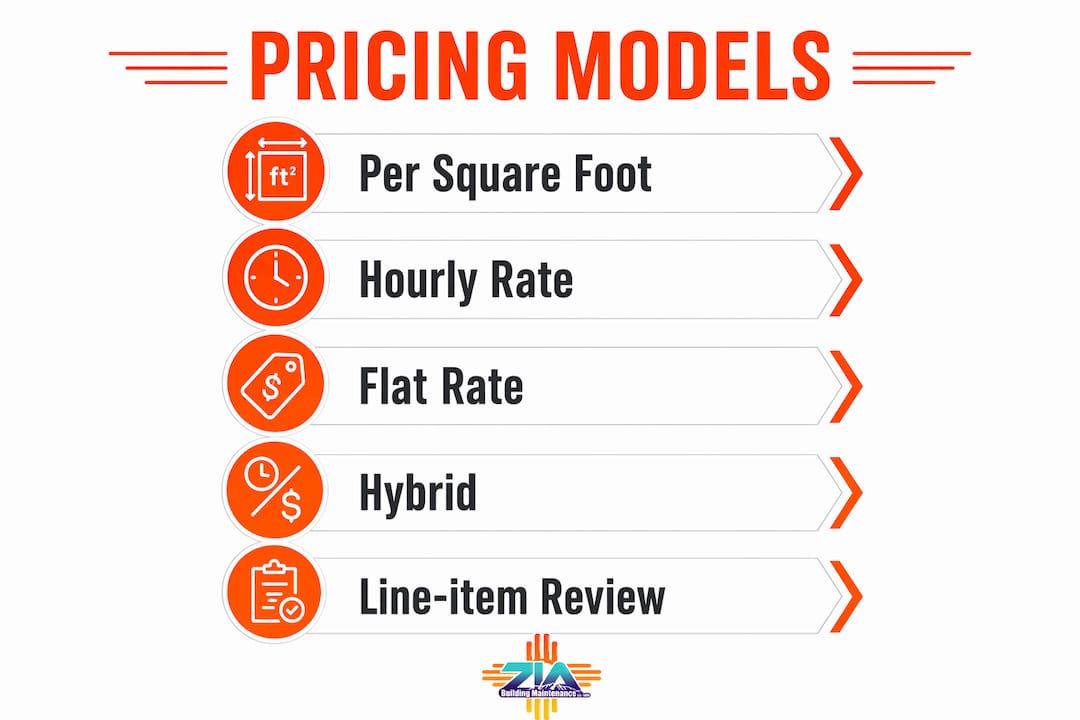
Flat rate contracts set a fixed monthly or weekly fee regardless of hours worked. Flat rate pricing works well for recurring contracts because both parties know the exact cost in advance. This model rewards efficient providers and gives managers a stable line item in their budget. The risk is that a poorly scoped flat rate can lead to rushed cleaning if the provider underestimates the time required.
4. Hybrid models
Hybrid pricing combines elements of two or more models. A provider might charge a flat monthly base rate for routine cleaning and add hourly billing for periodic deep cleaning or specialty services. This approach suits complex facilities with variable service needs across different zones or departments.
Pro Tip: Request a line-item breakdown from any provider using flat rate pricing. If they cannot show you the labor hours and task list behind the number, the scope is likely too vague to enforce.
| Pricing Model | Best Use Case | Key Advantage |
|---|---|---|
| Per square foot | Recurring office and retail cleaning | Easy to compare across providers |
| Hourly rate | One-time or irregular jobs | Transparent time tracking |
| Flat rate contract | Predictable recurring services | Stable monthly budget |
| Hybrid | Multi-service or complex facilities | Flexibility across service types |
How does facility type affect janitorial service pricing?
Facility type is one of the strongest drivers of price variation in any commercial cleaning pricing guide. A standard office building and a medical clinic may have identical square footage, yet their cleaning costs can differ significantly.

Medical facilities require strict sanitation protocols, regulated disinfectants, and staff trained in infection control. Medical facilities often command rates between $0.12 and $0.30 per square foot, compared to $0.07 to $0.25 for standard offices. That premium reflects compliance requirements under OSHA and HIPAA, not just extra labor time. Managers overseeing healthcare janitorial services should factor certification and training costs into any vendor evaluation.
Retail and industrial facilities sit in a different category. High foot traffic in retail spaces increases cleaning frequency requirements, which raises monthly costs even at a low per-square-foot rate. Industrial facilities often require specialty cleaning for machinery areas, hazardous material zones, or warehouse floors, which pushes pricing toward labor-based or hybrid models.
Specialized services add cost on top of the base rate. Carpet cleaning and hard floor maintenance are often priced separately, ranging from $0.08 to $0.60 per square foot depending on scope. Electrostatic disinfection typically costs between $0.10 and $0.30 per square foot. These add-ons are common in schools, medical offices, and food service facilities.
Pro Tip: Ask providers to separate specialty service pricing from routine cleaning in their proposals. Bundled pricing hides cost increases when specialty services are added or removed.
Cleaning frequency also affects the effective rate. A facility cleaned five days per week at $0.10 per square foot per month costs far less per visit than one cleaned once per week at the same monthly rate. Understanding the right cleaning frequency for your facility type prevents both overpaying and under-cleaning.
How do labor, supplies, and overhead factor into cleaning costs?
The janitorial service cost breakdown behind any proposal starts with labor. Janitorial wages average around $17.27 per hour per Bureau of Labor Statistics data. Fully loaded labor costs are higher after adding workers’ compensation, payroll taxes, and benefits. A provider paying $17.27 per hour in base wages may carry a fully loaded cost of $22 to $26 per hour. That gap explains why low-bid contracts often fail to deliver adequate staffing.
The break-even price for a janitorial contract is calculated as: fully loaded labor hours multiplied by the fully loaded hourly rate, plus direct supplies, plus overhead allocation. Each component must be accurate for the bid to be sustainable. Providers who skip overhead allocation in their calculations often underprice contracts and then cut corners on service to recover margin.
Supplies and consumables represent the second cost layer. Some providers track supplies by direct account, meaning they charge each client for actual products used. Others allocate supply costs proportionally across all accounts based on square footage or visit frequency. Direct account tracking is more accurate for facilities with high consumable use, such as restroom-heavy buildings or food service environments.
Overhead covers management time, insurance, equipment depreciation, and vehicle costs. A well-run janitorial company allocates overhead as a percentage of revenue, typically ranging from 15% to 30% depending on company size and service complexity. Managers evaluating proposals should ask how overhead is allocated. A provider who cannot answer that question is likely pricing by intuition rather than by calculation.
| Cost Component | What It Includes | Impact on Pricing |
|---|---|---|
| Fully loaded labor | Wages, taxes, workers’ comp, benefits | Largest single cost driver |
| Direct supplies | Cleaning products, consumables | Varies by facility type and use |
| Overhead allocation | Management, insurance, equipment | 15%–30% of contract value |
| Specialty services | Carpet care, disinfection, floor work | Priced separately or as add-ons |
What should managers know when negotiating janitorial contracts?
Evaluating a cleaning contract goes well beyond comparing headline rates. Square-foot pricing is best suited for predictable recurring services, but it can be misleading without considering labor hours and cleaning quality. A lower per-square-foot price often signals lower service quality rather than greater efficiency. Managers who select the lowest bid without examining the labor model behind it frequently face inconsistent results within the first 90 days.
Key questions to ask before signing any cleaning contract:
- What tasks are included in the base rate, and which are billed separately?
- How many labor hours per visit does the provider allocate to your facility?
- Does the contract define service levels and inspection standards in writing?
- How are supply costs tracked and reported?
- What is the process for addressing missed tasks or quality complaints?
Offering tiered pricing options such as basic, standard, and premium packages improves transparency and helps managers match service scope to budget. Providers who present clear scope tiers make it easier to scale services up or down as facility needs change. This structure also protects both parties when contract renewals come up.
Flat rate contracts benefit managers who need predictable budgeting and plan to scale services across multiple locations. Hourly pricing works better for one-time projects or facilities with irregular cleaning needs. Hybrid pricing suits complex facilities where routine cleaning and specialty services run on different schedules.
Pro Tip: Always request a production rate analysis from your provider. This document shows how many square feet one cleaner covers per hour in your specific facility type. It is the clearest indicator of whether the proposed labor hours are realistic.
The value of professional janitorial services extends beyond cleanliness. Consistent, well-scoped contracts reduce liability exposure, support employee health, and protect facility assets like flooring and fixtures. A contract with a clear scope and measurable service levels is worth more than a low-priced agreement with vague terms.
Key Takeaways
Janitorial service pricing structure is built on three core models: per square foot, hourly rate, and flat rate contracts, each suited to different facility types, service frequencies, and budget requirements.
| Point | Details |
|---|---|
| Three core pricing models | Per square foot, hourly rate, and flat rate contracts cover most commercial cleaning scenarios. |
| Facility type drives rate variation | Medical facilities command higher rates than standard offices due to compliance and sanitation requirements. |
| Labor is the largest cost driver | Fully loaded labor costs exceed base wages after taxes, insurance, and benefits are added. |
| Low bids often signal low quality | A lower per-square-foot price typically reflects fewer labor hours, not greater efficiency. |
| Scope clarity protects both parties | Contracts with defined task lists, service tiers, and inspection standards reduce disputes and budget surprises. |
What experienced managers get right about janitorial pricing
Most pricing disputes I have seen come down to one problem: managers compare per-square-foot rates without knowing what labor model sits behind them. Two bids at $0.10 per square foot can represent completely different service levels if one provider allocates 20 cleaner hours per month and the other allocates 12. The rate looks identical. The result does not.
The most effective approach I have observed is treating square-foot pricing as a rough benchmark, not a final decision tool. Production hours are what actually drive contract value and cleaning quality. Managers who ask for a labor hour breakdown before signing a contract consistently report fewer quality complaints and fewer mid-contract renegotiations.
Hybrid pricing models deserve more attention than they typically get. A flat rate base with hourly add-ons for specialty work gives managers budget predictability on routine cleaning while keeping specialty services transparent and controllable. That structure works especially well in facilities like schools or medical offices where deep cleaning and disinfection cycles run on a separate schedule from daily maintenance.
Transparency is the clearest indicator of a trustworthy provider. A company that can show you its break-even calculation, its fully loaded labor rate, and its overhead allocation is a company that prices with discipline. That discipline shows up in service consistency over the life of the contract.
— Ashley
Zia Building Maintenance: tailored pricing for every facility type
Zia Building Maintenance has served commercial facilities across Albuquerque since 1989, building a reputation for consistent, transparent service across offices, medical facilities, and schools.
Zia Building Maintenance structures every contract around your facility’s actual needs, not a generic rate sheet. Whether you need a flat rate agreement for predictable monthly budgeting or a hybrid plan that separates routine cleaning from specialty floor care, the team builds a scope that reflects your real cleaning requirements. Every proposal includes a clear task list, defined service levels, and transparent cost components. Explore how professional janitorial services can reduce your facility costs while maintaining a spotless, professional environment. Request an estimate from Zia Building Maintenance and get a pricing structure built for your building.
FAQ
What is the most common janitorial pricing model?
Per square foot pricing is the most widely used model for recurring commercial cleaning contracts. Standard office rates range from $0.07 to $0.25 per square foot per month, depending on scope and frequency.
When should a business use hourly janitorial pricing?
Hourly pricing suits one-time jobs, post-construction cleanups, or irregular deep cleaning visits. Providers typically charge $25 to $90 per cleaner hour for these non-recurring projects.
Why do medical facilities pay more for janitorial services?
Medical facilities require compliance with OSHA and HIPAA sanitation standards, specialized disinfectants, and trained staff. These requirements push rates to $0.12–$0.30 per square foot, above standard office pricing.
What is included in a janitorial service cost breakdown?
A complete cost breakdown includes fully loaded labor, direct supplies, overhead allocation, and any specialty service fees. Labor is the largest component, with fully loaded costs exceeding base wages after taxes and insurance.
How can managers avoid underbid janitorial contracts?
Request a production rate analysis showing labor hours allocated per visit. A low per-square-foot price paired with insufficient labor hours signals a contract that cannot deliver consistent cleaning quality.