

Introduction: The Critical Need for Pristine Retail Flooring
Efficient mall carpet shampooing combines targeted pre-spray emulsification, mechanical agitation, dual-method hot water extraction or very low moisture (VLM) encapsulation, and high-velocity drying to restore heavy-traffic retail corridors with minimal operational downtime. Executing this systematic floor care process removes abrasive grit, dissolves stubborn oily residues, and protects commercial carpet assets while keeping common concourses clean and safe for shoppers.
When visitors enter a retail center, the condition of the flooring sets the tone for their entire experience. Clean, vibrant carpets signal attention to detail, safety, and quality. In contrast, soiled walkways and visible traffic lanes convey neglect, directly dampening customer dwell time and weakening overall brand perception. In busy shopping environments across Albuquerque, Rio Rancho, Corrales, and Los Ranchos, maintaining clean flooring is both an aesthetic priority and a core operational requirement.
Every day, thousands of visitors carry dirt, grease, outdoor moisture, and beverage residues across common areas. Beyond visual appeal, carpet serves as an active air filter in large commercial spaces, trapping airborne dust, particulate matter, and allergens. When carpets become overloaded with particulate soil, foot traffic grinds these abrasive granules against delicate fibers, causing premature wear and increasing slip-and-fall liability near transitions between carpeting and hard surfaces such as tile or terrazzo.
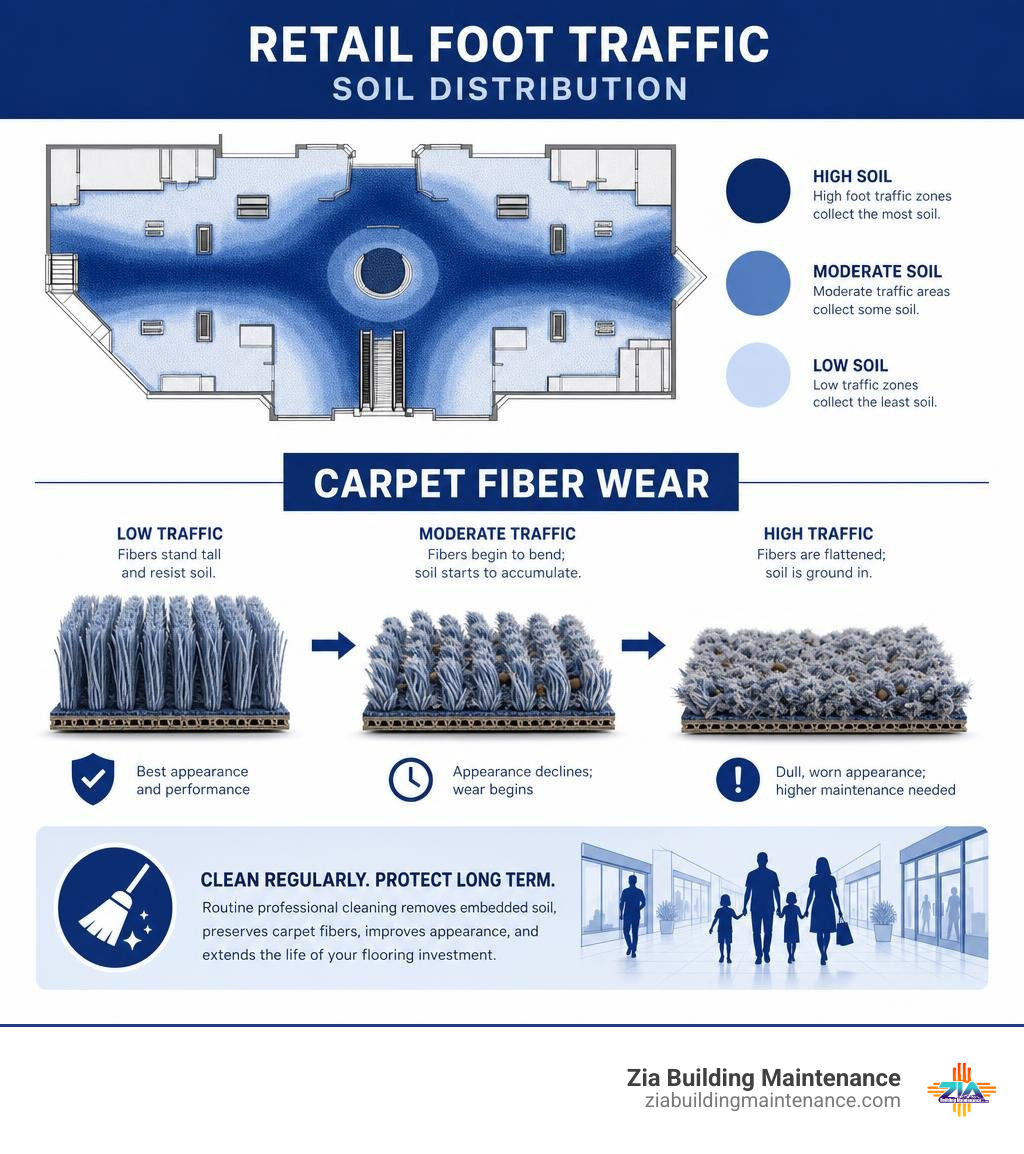
Implementing a consistent, professional maintenance strategy protects your facility’s long-term flooring investment, preserves indoor air quality, and creates a welcoming atmosphere that keeps shoppers browsing longer.
Core Cleaning Technologies and Preventive Floor Care Strategies
Managing high-traffic commercial flooring requires a clear understanding of soil composition. In a typical retail facility, approximately 85% of tracked-in soil is dry particulate matter (such as sand, clay, and grit), while the remaining 15% consists of oily binders (such as asphalt sealer residue, automotive grease, cooking vapors, and spilled food).
Dry soil acts like microscopic sandpaper under foot traffic, scratching and degrading carpet yarn over time. To protect commercial flooring assets, facility managers rely on a multi-tiered floor care service that pairs daily soil containment with advanced chemical and mechanical extraction methods, aligning directly with established Shaw Contract commercial carpet maintenance guidelines.
Choosing the Right Methods for Mall Carpet Shampooing
Not all commercial carpet cleaning techniques yield the same results. Selecting the appropriate system depends on foot traffic levels, allowable drying windows, and the type of soil present.
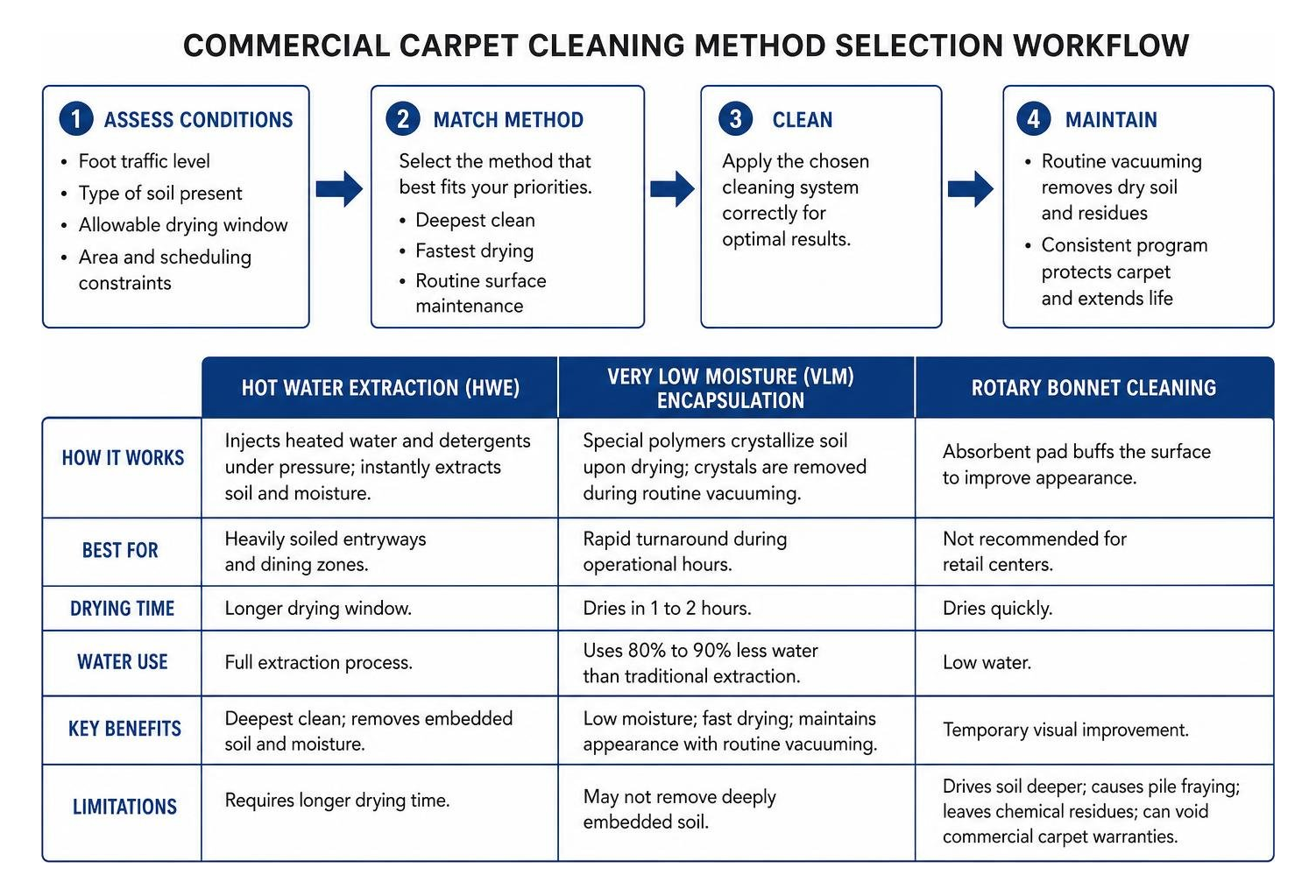
- Hot Water Extraction (HWE): Frequently referred to as deep steam extraction, this method injects heated water and specialized detergents into the carpet pile under pressure, instantly vacuuming up the suspended soil and moisture. It provides the deepest clean and is essential for heavily soiled entryways and dining zones. Equipment featuring a Carpet and Rug Institute (CRI) Gold rating ensures maximum soil recovery with minimal residual moisture.
- Very Low Moisture (VLM) / Encapsulation: VLM utilizes specialized polymers and high-energy foaming agents that surround and crystallize soil particles upon contact. As the solution dries over 1 to 2 hours, the brittle polymer-soil crystals detach from carpet fibers and are readily removed during routine vacuuming. VLM uses 80% to 90% less water than traditional extraction, making it ideal for rapid turnaround intervals during operational hours.
- Bonnet Cleaning (Rotary Pad): Bonnet cleaning uses an absorbent yarn pad mounted on a rotary floor machine to buff the carpet surface. While it offers temporary visual improvement, bonnet cleaning carries significant drawbacks for retail centers: it drives soil deeper into the backing, causes mechanical pile fraying, leaves chemical residues, and can void commercial carpet warranties.
| Feature / Metric | Hot Water Extraction (HWE) | Very Low Moisture (VLM) Encapsulation | Rotary Bonnet Cleaning |
|---|---|---|---|
| Cleaning Depth | Deep restorative clean (backing to tip) | Intermediate surface & mid-pile clean | Surface-level buffing only |
| Typical Drying Time | 4 to 8 hours (with air movers) | 1 to 2 hours | 1 to 3 hours |
| Water Usage | High volume (requires recovery) | Low volume (80–90% reduction) | Low to medium |
| Soil Removal Efficacy | Complete removal of oily & deep soil | Encapsulates soil for dry vacuuming | Shifts soil onto pad; pushes rest down |
| Fiber Wear Risk | Minimal (when properly executed) | Minimal | High (rotary pad friction damages pile) |
| Warranty Compliance | Fully supported by major mills | Widely supported as interim method | Disallowed by most major manufacturers |
Preventive Soil Defense and Daily Maintenance
Preventing soil from entering your facility is far more economical than extracting it after it becomes embedded. The cost of capturing and removing a single pound of dirt once it disperses into a commercial building can easily reach $500 or more.
A comprehensive preventive defense program involves:
- Dual-Mat Entry Systems: Install aggressive, coarse-textured scraper mats outside main mall entrances to catch coarse sand and grit, followed by water-absorbent walk-off mats inside concourses. A minimum of 15 to 20 linear feet of matting captures up to 85% of soil before it reaches primary retail carpets.
- Daily Commercial Vacuuming: Utilize high-efficiency dual-motor commercial upright vacuums equipped with rotating brushes. High-traffic corridors require daily vacuuming, with vacuum collection bags replaced before they reach two-thirds full to maintain maximum airflow suction.
- Routine Pile Lifting: Incorporate mechanical pile lifters ahead of deep cleans to stand crushed fibers upright, breaking loose compacted sand and gritty particles.
- Traffic Lane Management: Commercial loop-pile carpet masks soil buildup effectively at first. However, once soil density exceeds carpet thresholds—typically within 6 to 9 months in retail settings—a noticeable dark lane appears. Regular maintenance prevents these traffic lanes from setting permanently, a vital standard in routine strip mall maintenance.
Step-by-Step Execution of Mall Carpet Shampooing
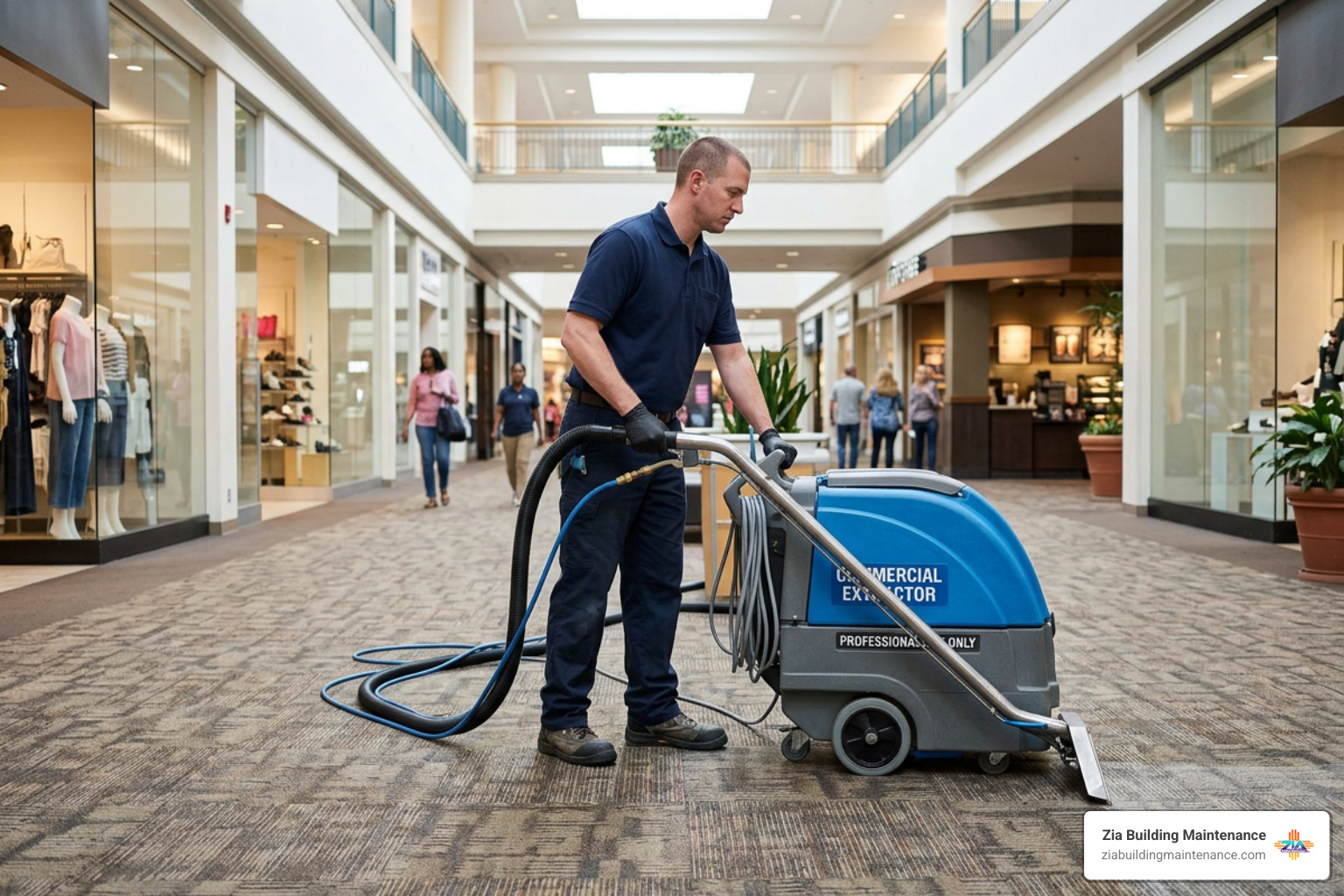
Achieving thorough, uniform cleaning across vast square footages requires a methodical, step-by-step approach:
wp:html
/wp:html
wp:html
/wp:html
Applying proper technique protects carpet backing from over-wetting, ensures even color revival, and keeps equipment operating smoothly. Facility teams should follow proven carpet steam cleaner tips to avoid common operational errors.
Pre-Treatment and Spot Removal Protocols
Before running large extraction equipment, targeted pre-treatment breaks the chemical bonds between oily soils and synthetic fibers:
- Zone Mapping and Inspection: Inspect work zones for stubborn spots, identifying whether stains are organic, petroleum-based, or synthetic dye spills. Knowing how to handle common carpet stains ensures the correct spotter chemistry is used.
- Traffic Lane Pre-Spray Application: Apply a CRI-approved, low-VOC traffic lane cleaner with a pH level between 7.0 and 9.0 (keeping pH between 6.0 and 8.0 for printed or sensitive fibers).
- Dwell Time: Allow the pre-spray to dwell for 10 to 15 minutes. This dwell time allows the surfactants to emulsify ground-in grease without letting the carpet dry out.
- Agitation: Agitate the pre-spray using a counter-rotating brush (CRB) machine to lift the pile and work the cleaning agent evenly through the fiber structure.
- Spot Treatment Technique: For spot cleaning, gently tamp and blot with clean microfiber towels, working from the outer perimeter of the spot inward to avoid spreading the stain. Never scrub vigorously, as this frays the carpet yarn twist.
Equipment Setup and Machine Operation
Operating self-contained commercial extractors requires strict adherence to manufacturer parameters, as outlined in standard commercial carpet extractor operating specifications:
- Solution Tank Preparation: Fill the solution tank with clean water mixed with properly diluted, low-residue extraction rinse. Maintain water temperatures at or below 122°F (50°C) to prevent thermal shock to carpet adhesives and latex backing.
- Calibrated Brush Pressure: Adjust the mechanical cylindrical brush to maintain consistent pressure (typically around 25 lbs). This provides optimal mechanical scrubbing without abrading loop-pile fibers.
- Controlled Extraction Passes: Pull the extractor backward in steady, straight paths, overlapping each pass by approximately 2 inches (50 mm) to eliminate untreated stripes and uneven drying.
- Moisture Recovery: Execute a dedicated dry vacuum pass over freshly extracted sections to pull out lingering moisture and accelerate dry times.
- Intake and Float Maintenance: Monitor the recovery tank’s shut-off float mechanism. Empty the recovery tank as soon as water pickup stops, clearing the vacuum intake screen of lint and debris to maintain strong airflow suction.
Operational Logistics: Scheduling, Frequency, and Safety
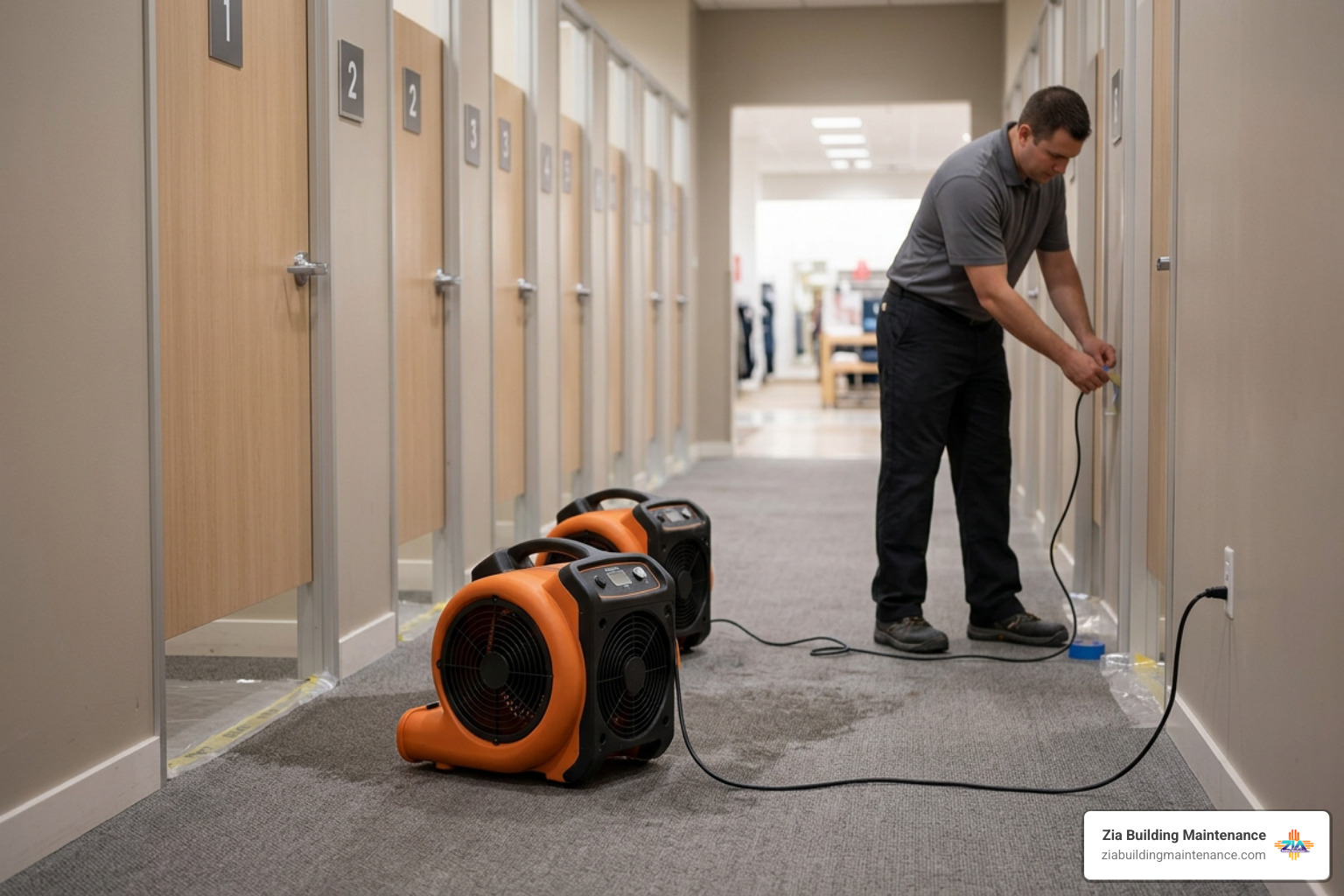
Large shopping centers require strict operational scheduling to maintain clean floors without interrupting daily retail business.
Minimizing Retail Disruption During Mall Carpet Shampooing
- Overnight and Off-Hours Windows: Coordinate deep extraction during closed hours (typically 10:00 PM to 7:00 AM). Working during this window gives facilities ample time to complete pre-treatment, extraction, and post-drying before storefronts open.
- Air Movement Optimization: Position high-velocity commercial axial air movers immediately behind extraction paths. Directing continuous airflow across carpet surfaces reduces drying times down to 2 to 4 hours, preventing tackiness and avoiding musty odors.
- Low-Odor Chemistry: Select non-toxic, eco-friendly, and fragrance-neutral cleaning formulations to avoid lingering chemical odors in enclosed retail corridors.
- Storefront Protection: Place moisture barriers and corner guards around tenant storefront fixtures, display kiosks, and polished hard-floor borders.
- Electrical and Slip Safety: Manage power cords cleanly to avoid trip hazards, and place high-visibility wet floor warning signs at all transitions between carpeted zones and hard tile flooring. Partnering with a dedicated commercial carpet cleaning service ensures that trained technicians carry out these safety measures consistently.
Recommended Deep-Cleaning Frequencies by Traffic Zone
Carpet maintenance schedules should match the foot traffic volume of each area:
- Extra-Heavy Traffic (Main Entrances, Food Courts, Escalator Landings): Monthly hot water extraction paired with bi-weekly or monthly interim VLM foaming.
- Heavy Traffic (Anchor Store Corridors, Restroom Approaches, Center Courts): Quarterly hot water extraction combined with bi-monthly interim surface cleaning.
- Moderate Traffic (Secondary Corridors, Management Offices, Specialty Boutiques): Semi-annual to annual deep extraction with regular spot care.
Frequently Asked Questions About Shopping Center Carpet Care
How often should high-traffic mall carpets undergo deep extraction?
Extra-heavy retail traffic zones—such as main concourse entries, ticket kiosks, and food courts—require deep hot water extraction every 30 days. Standard anchor store corridors and boutique walkways should receive deep extraction at least quarterly. Regular cleaning keeps soil levels well below the 6-to-9-month threshold where compacted dirt creates permanent traffic stripes.
Why is traditional bonnet cleaning discouraged for commercial mall carpets?
Bonnet cleaning only cleans the top surface of the carpet fibers while driving deeper grit and sand down toward the backing. The spinning friction of rotary pads can untwist and fray commercial loop-pile fibers. Additionally, bonnet shampooing often leaves sticky chemical residues behind that attract new dirt faster, and using it can void major commercial carpet manufacturer warranties.
What is the fastest drying method for active retail carpets?
Very Low Moisture (VLM) encapsulation is the fastest commercial cleaning method, drying in 1 to 2 hours. By encapsulating soil particles in microscopic polymer crystals with minimal water, it allows high-traffic retail spaces and boutique shops to reopen almost immediately without risking moisture-related mold or backing delamination.
Conclusion: Elevating the Retail Experience Through Professional Floor Care
A well-maintained carpet is quiet proof of a clean, well-managed shopping center. Keeping commercial carpets fresh, spotless, and hygienic protects multi-million-dollar retail assets, prolongs carpet lifespan, and provides shoppers with a comfortable, attractive environment.
At Zia Building Maintenance, we provide dependable, detail-focused janitorial and specialty floor care services for shopping centers and retail spaces throughout Albuquerque, Rio Rancho, Corrales, and Los Ranchos. Whether you oversee bustling commercial centers or specialty properties highlighted in our guide to Albuquerque commercial retail centers, our experienced team delivers consistent, professional results. Contact us today to build a custom commercial carpet maintenance program tailored to your facility’s traffic, budget, and operational schedule.