

TL;DR:
- Retail restroom hygiene influences customer confidence and business performance. Proper standards, scheduling based on traffic, and thorough documentation ensure legal compliance and customer satisfaction. Treating restroom cleaning as a key brand decision helps prevent costly reactive repairs and negative reviews.
Retail restroom cleaning standards are the defined procedures, frequencies, and appearance benchmarks that keep public restrooms hygienic, legally compliant, and welcoming to customers. The industry term for this framework is “restroom sanitation standards,” and it draws from OSHA 29 CFR 1910.141, APPA custodial appearance levels, and ISSA frequency benchmarks. 68% of Americans are more likely to return and spend more at businesses with clean restrooms. That single statistic makes restroom hygiene a direct revenue issue, not just a housekeeping task. Retail facility managers who treat these standards as a compliance checkbox miss the bigger picture entirely.
What regulatory and industry standards govern retail restroom cleaning?
OSHA 29 CFR 1910.141 sets the legal floor for restroom sanitation in commercial facilities. It mandates minimum toilet counts based on employee numbers, requires soap and hand drying options at every handwashing station, and demands that fixtures remain functional at all times. Serious violations can result in fines up to $16,550 per citation. That is not a theoretical risk. OSHA inspectors cite restroom deficiencies regularly, and retail environments with high public foot traffic draw extra scrutiny.
Beyond OSHA, the APPA (Association of Physical Plant Administrators) custodial appearance levels give facility managers a practical quality scale. Level 1 is “orderly spotlessness,” with no visible soil, odor, or litter. Level 2 is “ordinary tidiness,” acceptable for most retail settings. Level 3 shows noticeable deterioration and is the minimum many retailers tolerate before escalating a cleaning response. Most retail operators should target Level 2 as a baseline and Level 1 for flagship or high-visibility locations.
The ISSA (International Sanitary Supply Association) adds frequency benchmarks tied to traffic volume. These benchmarks translate foot traffic counts into cleaning visit requirements, giving managers a defensible standard when setting service contracts. A detailed scope of work that includes frequency, appearance standards, and deficiency notification is the foundation of any enforceable cleaning agreement.
Key regulatory requirements at a glance:
- Toilet paper, soap, and hand drying must be available at all times under OSHA 1910.141
- Fixtures must be maintained in working order; broken faucets or dispensers are citable defects
- Ventilation must meet ASHRAE Standard 62.1 minimums to control odor and air quality
- Cleaning logs must be available for inspection to demonstrate compliance history
- Supply shortfalls, such as empty soap dispensers, are among the most common OSHA findings during facility inspections
How do you build a cleaning schedule based on retail traffic?
Traffic volume is the single most important variable in any restroom cleaning schedule. A boutique with 200 daily visitors needs a very different plan than a big-box store processing 3,000. The ISSA traffic classification system groups facilities into low, medium, high, and extremely high volume tiers, each with corresponding cleaning frequencies.
- Low traffic (under 150 users per day): One full cleaning visit daily, with a mid-shift supply check. Focus on toilet and sink sanitation, floor mopping, and consumable restocking.
- Medium traffic (150–500 users per day): Two full cleaning visits daily. Add a visual inspection between visits to catch spills, empty dispensers, or odor issues early.
- High traffic (500–1,500 users per day): Two full cleaning visits daily plus mid-shift supply monitoring. Assign a dedicated attendant during peak hours when possible.
- Extremely high traffic (over 1,500 users per day): Condition-based or IoT sensor-triggered cleaning dispatch. Fixed time schedules alone cannot keep pace with variable demand at this volume.
The table below summarizes recommended cleaning actions by traffic tier.
| Traffic Tier | Daily Visits | Mid-Shift Check | Peak-Hour Coverage |
|---|---|---|---|
| Low | 1 | Yes | Not required |
| Medium | 2 | Yes | Recommended |
| High | 2 | Yes | Strongly recommended |
| Extremely high | 2+ | Continuous | Required |
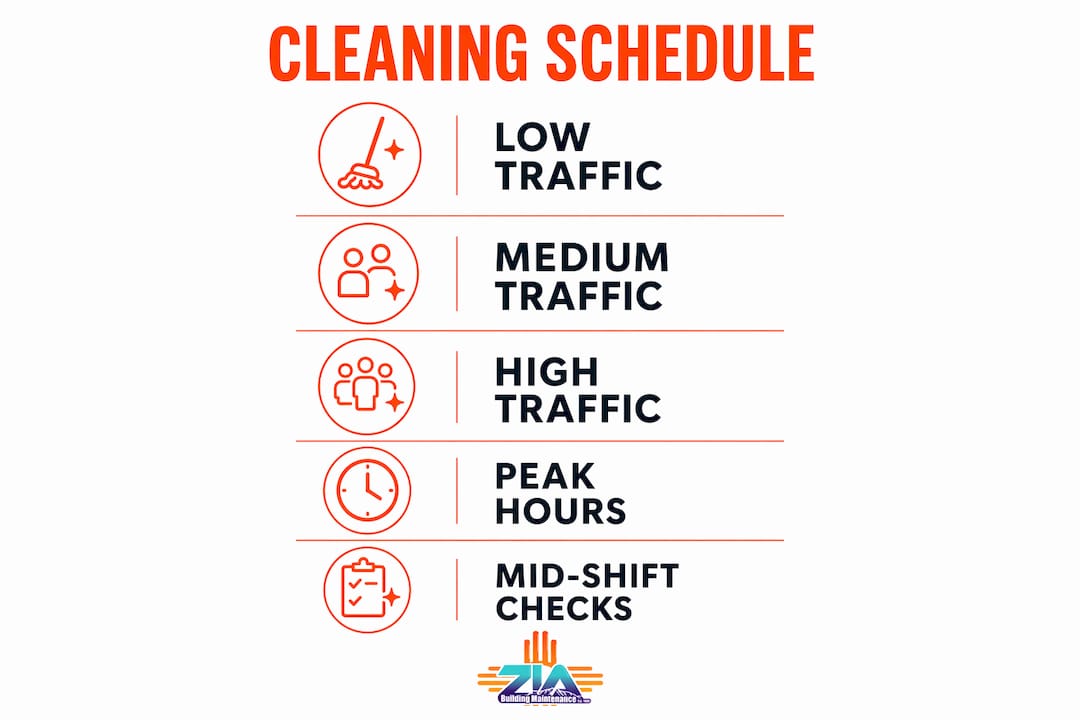
Fixed time schedules alone are insufficient for high-volume retail restrooms. Condition-based models respond to actual usage rather than the clock, which prevents hygiene gaps during unexpected surges like holiday weekends or sales events.
Pro Tip: Use fixture count-based labor calculations rather than square footage estimates when staffing restroom cleaning. Counting toilets, sinks, and urinals gives a more accurate time estimate per visit and prevents understaffing during busy periods.
For a practical starting point, the retail store cleaning routine guide from Zia Building Maintenance outlines task checklists specifically designed for high-traffic retail environments.
What are the best practices for cleaning procedures and product selection?
A complete restroom cleaning visit follows a top-to-bottom, clean-to-dirty sequence. Starting at the highest surfaces and working down prevents recontamination of already-cleaned areas. Every visit should cover the following:
- Ventilation grilles and light fixtures: Dust and wipe monthly; check for blockages at every visit
- Mirrors and glass: Spray with a glass cleaner and wipe with a lint-free cloth
- Countertops and sinks: Apply an EPA-registered disinfectant, allow the required contact time, then wipe clean
- Toilets and urinals: Apply bowl cleaner inside the bowl first, then disinfect exterior surfaces including the flush handle, seat, and base
- High-touch points: Door handles, lock latches, paper towel dispensers, and soap pump heads require disinfectant at every visit
- Floors: Sweep or dry mop first, then wet mop with a disinfectant solution; pay attention to grout lines and corners
Disinfectant contact time is the most commonly skipped step in retail restroom cleaning. An EPA-registered disinfectant must remain visibly wet on a surface for the full dwell time listed on its label, typically 30 seconds to 10 minutes depending on the product and pathogen target. Staff training on contact time compliance is critical during high-traffic cleaning to achieve true pathogen kill claims. Wiping a surface dry immediately after application renders the disinfectant ineffective.
Touchless fixtures are a meaningful upgrade for high-traffic retail restrooms. Nearly 80% of Americans value touchless faucets, dispensers, and flushers in public restrooms. Touchless fixtures also reduce surface contamination between cleaning visits, which lowers the cleaning labor needed to maintain appearance standards.
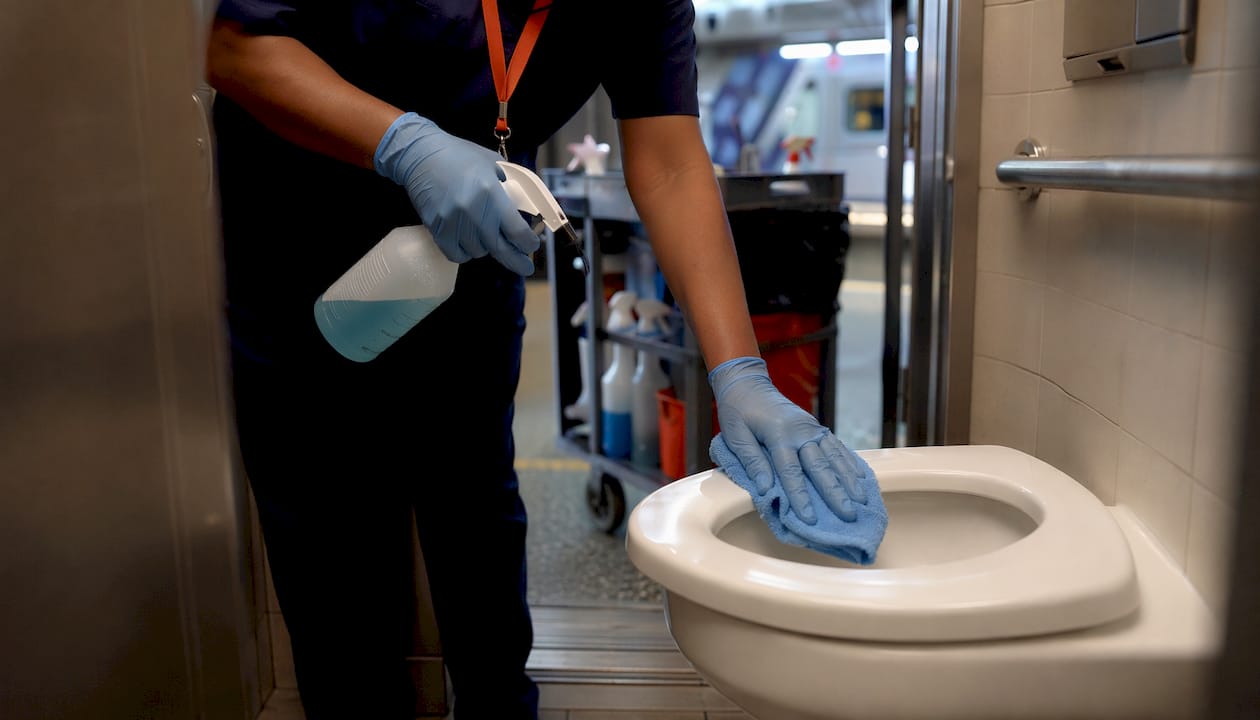
Pro Tip: Color-code your cleaning cloths by zone. Use one color for toilets and urinals, a second for sinks and countertops, and a third for mirrors and glass. This prevents cross-contamination and makes training faster for new staff.
For guidance on selecting the right products, the professional restroom deep-clean guide covers effective disinfectants and tools used by commercial cleaning teams.
How do you manage supplies, maintenance, and documentation for compliance?
Supply management and record keeping are where most retail restroom programs break down. Running out of soap or paper towels is not just an inconvenience. Failure to maintain soap, paper towels, and functional fixtures results in hygiene lapses, user dissatisfaction, and compliance violations under OSHA 1910.141.
A reliable supply protocol follows four steps:
- Set par levels: Determine the minimum quantity of each consumable (toilet paper rolls, soap cartridges, paper towel packs) that must be on hand before restocking is triggered.
- Check at every visit: Attendants confirm supply levels during each cleaning visit and restock immediately rather than waiting for a separate supply run.
- Log every check: Record the time, attendant name, and supply status in a written or digital log. This log is your primary evidence of compliance during an OSHA inspection.
- Report maintenance issues immediately: Broken fixtures, leaking faucets, or non-functional hand dryers go into a maintenance notification system the same day they are discovered.
“Cleaning documentation with time-stamped logs and maintenance notifications is crucial to demonstrate compliance and avoid OSHA citations. A log that shows regular, consistent service is your best defense during an unannounced inspection.”
Time-stamped cleaning logs serve two purposes. They prove compliance to regulators, and they reveal patterns, such as which days or hours generate the most supply depletion, so managers can adjust staffing and restocking schedules accordingly. For managers building or reviewing service agreements, the commercial cleaning contract checklist provides a framework for including documentation requirements in vendor contracts.
What are the most common challenges in retail restroom cleaning?
Persistent odor is the complaint facility managers hear most often from customers. The root cause is usually inadequate ventilation, not insufficient cleaning frequency. Cleaning ventilation grilles monthly prevents blockages that trap odors, and coordinating with building maintenance to verify ASHRAE Standard 62.1 airflow rates resolves problems that cleaning alone cannot fix.
Other frequent challenges include:
- Peak-hour hygiene gaps: A restroom cleaned at 9:00 AM can be in poor condition by noon on a busy Saturday. Assign an attendant or set sensor alerts to trigger a spot-clean during high-traffic windows.
- Inconsistent disinfectant application: Staff under time pressure often skip dwell times. Post laminated dwell-time reference cards inside supply closets to keep the standard visible and non-negotiable.
- Fixture malfunctions going unreported: A broken soap dispenser can sit empty for hours if no one has a clear reporting path. A simple text-based maintenance alert system solves this without requiring expensive software.
- Training gaps in new staff: New attendants default to their own habits without structured onboarding. A one-page visual cleaning sequence posted in the supply closet reduces errors immediately.
Pro Tip: Schedule a monthly “deep audit” where a manager walks the restroom with the same checklist used by cleaning staff. Discrepancies between the log and actual conditions reveal training gaps or reporting problems before they become compliance issues.
Key takeaways
Retail restroom hygiene is a direct driver of customer retention, legal compliance, and brand reputation, and it requires structured standards, not ad hoc cleaning.
| Point | Details |
|---|---|
| Regulatory baseline | OSHA 29 CFR 1910.141 sets minimum requirements; violations carry fines up to $16,550 per citation. |
| Traffic-based scheduling | Match cleaning frequency to foot traffic using ISSA tiers; high-volume stores need two visits daily plus mid-shift checks. |
| Disinfectant contact time | Allow the full EPA-listed dwell time on every surface; skipping this step makes disinfection ineffective. |
| Documentation is compliance | Time-stamped logs and maintenance reports are your primary defense during OSHA inspections. |
| Touchless fixtures reduce risk | Nearly 80% of Americans value touchless fixtures, and they lower surface contamination between cleaning visits. |
Why restroom cleaning is actually a brand decision
I have worked with facility managers who treat restroom cleaning as the last line item on the budget and the first to get cut when costs rise. That approach consistently backfires. The Bradley Company 2026 survey finding that 86% of Americans expect restroom quality to reflect overall business quality is not surprising to anyone who has managed a retail facility. Customers draw conclusions fast, and a dirty restroom confirms every doubt they had about your store.
What I find most managers underestimate is the labor cost of reactive cleaning. Responding to complaints, emergency restocks, and odor complaints costs more in staff time than a well-structured preventive schedule. Investing in IoT-triggered dispatch or a dedicated peak-hour attendant sounds expensive until you calculate the cost of a single negative online review that mentions restroom conditions.
The other thing worth saying plainly: compliance and quality are not the same target. OSHA minimums keep you out of legal trouble. APPA Level 1 keeps customers coming back. The managers who understand that distinction build restroom programs that serve both goals simultaneously, and they rarely have to choose between cost control and customer satisfaction.
Restroom cleanliness is a brand decision. Treat it like one.
— Ashley
Zia Building Maintenance: a trusted partner for retail restroom standards
Retail facility managers in Albuquerque and the surrounding area have relied on Zia Building Maintenance since 1989 for consistent, compliant commercial restroom cleaning. Zia’s team understands the specific demands of high-traffic retail environments, from supply management and fixture monitoring to time-stamped documentation that holds up during inspections.
Zia Building Maintenance builds cleaning schedules around your actual foot traffic patterns, not a generic template. Every service plan includes supply monitoring, maintenance reporting, and the detailed logs that protect you during OSHA reviews. Learn how professional janitorial services reduce both cleaning costs and compliance risk for retail businesses. Contact Zia Building Maintenance to request a consultation and get a cleaning plan matched to your facility’s specific needs.
FAQ
What is a restroom sanitation standard?
A restroom sanitation standard is a defined set of cleaning procedures, frequencies, and appearance benchmarks that keep a restroom hygienic and compliant. In retail settings, these standards draw from OSHA 29 CFR 1910.141, APPA custodial appearance levels, and ISSA frequency benchmarks.
How often should a retail restroom be cleaned?
High-traffic retail restrooms require at least two full cleaning visits daily plus mid-shift supply checks. Extremely high-volume locations benefit from condition-based or IoT sensor-triggered cleaning to address demand spikes in real time.
What does OSHA require for retail restrooms?
OSHA 29 CFR 1910.141 requires functional toilets in numbers proportional to employees, plus soap, hand drying options, and toilet paper at all times. Violations carry fines up to $16,550 per citation.
Why do retail restrooms still smell after cleaning?
Persistent odor usually points to inadequate ventilation rather than insufficient cleaning. Blocked or dirty ventilation grilles trap odors regardless of cleaning frequency. Cleaning grilles monthly and verifying airflow against ASHRAE Standard 62.1 resolves most odor complaints.
What records do I need to show OSHA compliance?
Time-stamped cleaning logs, supply check records, and maintenance notification reports are the primary documents OSHA inspectors review. Consistent, dated logs showing regular service are your strongest evidence of compliance.