How to Clean Church Pew Cushions and Fabric Upholstery
Why Church Pew Upholstery Cleaning Matters More Than You Think
Church pew upholstery cleaning is the process of removing dirt, allergens, bacteria, and stains from the fabric cushions and padded surfaces of church pews — and it’s one of the most overlooked maintenance tasks in any worship facility.
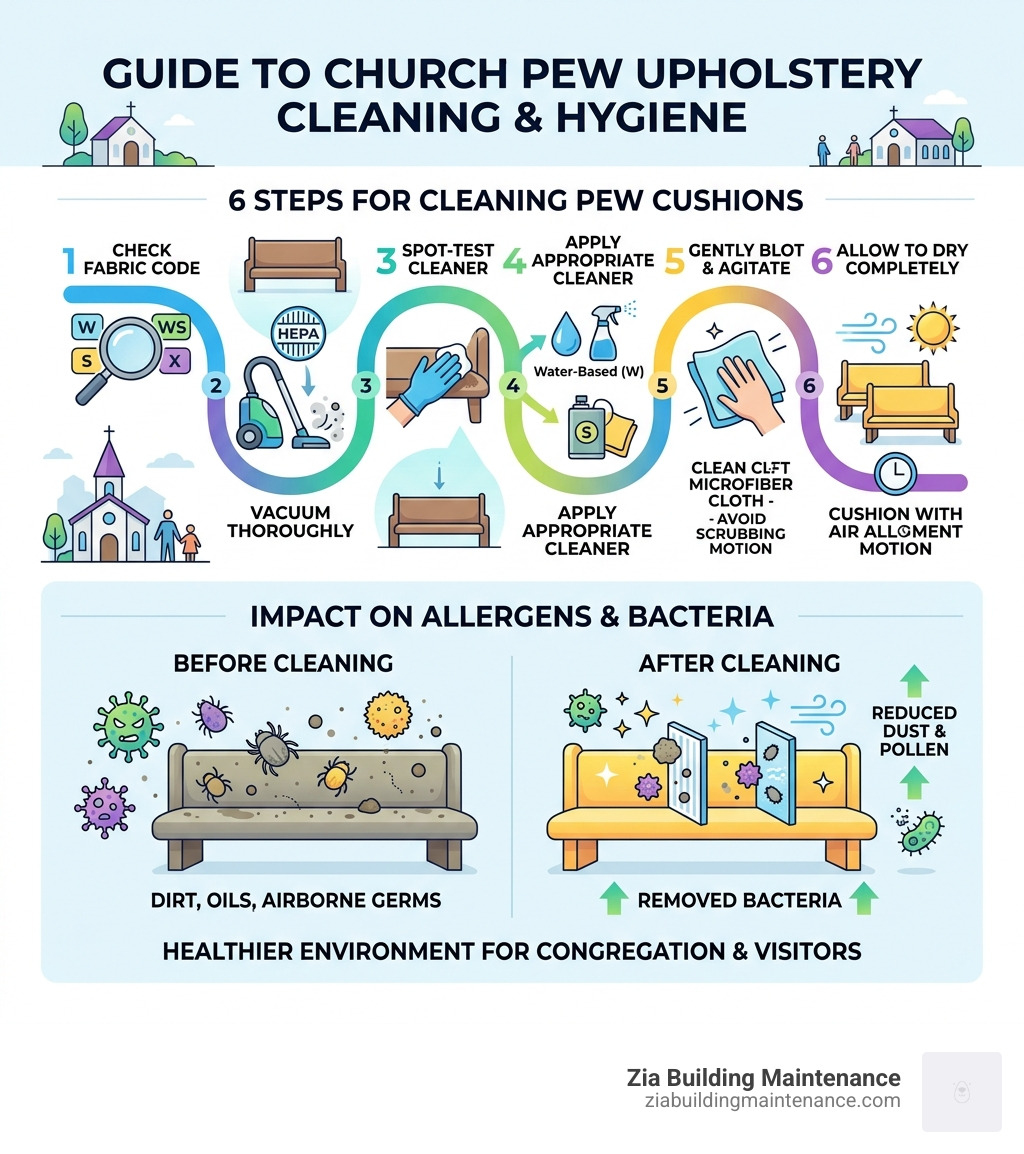
Here’s a quick answer on how to clean church pew upholstery:
- Check the fabric code on the cushion label (W, WS, S, or X) to know which cleaners are safe
- Vacuum thoroughly using an upholstery attachment with a HEPA filter, including edges and crevices
- Spot-test your cleaner on a hidden area before applying it to the full surface
- Apply the appropriate cleaner — water-based for W fabrics, solvent-based for S fabrics
- Blot and agitate gently with a clean microfiber cloth — never scrub or saturate
- Allow to dry completely before the next service
Pews are touched by hundreds of people every week. They collect body oils, dust, food residue, and airborne germs with every service. Yet most churches clean their floors far more often than their seating.
The result? Cushions that look worn, smell stale, and quietly undermine the welcoming atmosphere your congregation works so hard to create.
Visitors notice your pews before almost anything else in the sanctuary. Worn or soiled cushions can leave a lasting negative impression — even in a beautifully decorated space.
I’m Ashley Cordova, Vice President of Zia Building Maintenance, a family-owned janitorial company serving New Mexico since 1989, and church pew upholstery cleaning is one of the specialized services our team handles regularly for religious facilities across the region. In this guide, I’ll walk you through everything you need to know — from reading fabric codes to knowing when it’s time to call in professionals.
Important church pew upholstery cleaning terms:
The Importance of Regular Church Pew Upholstery Cleaning
When we step into a historic sanctuary in Downtown Albuquerque, we aren’t just looking at the architecture; we’re looking at the surfaces that support the community. Regular church pew upholstery cleaning is vital because these fabrics act like giant filters. They trap dust, skin cells, and pollen every time someone sits down or stands up.
The statistics are eye-opening. Professional cleaning can remove an average of 94% of allergens from carpets and similar percentages from upholstered surfaces. When you consider that professional steam cleaning can eliminate up to 99.9% of bacteria, the health implications for your congregation become clear. Neglecting these surfaces doesn’t just make the room look “dingy”—it can actually lower the indoor air quality, making the sanctuary less comfortable for those with respiratory sensitivities. You can read more about the impact of dirty carpets and upholstery on air quality to understand how these hidden pollutants affect the environment.
Improving Sanctuary Hygiene in Albuquerque
In a high-desert environment like Albuquerque, dust is a constant battle. Between the seasonal winds and the high foot traffic during Sunday services and mid-week events, pews accumulate a surprising amount of grit. This grit acts like sandpaper, grinding into the fabric fibers every time a parishioner shifts in their seat.
By prioritizing hygiene, we protect the most vulnerable members of our community—the elderly and children—who are more susceptible to germs and allergens. A clean sanctuary isn’t just about appearances; it’s a form of ministry that shows care for the physical well-being of every person who enters. For those looking to go deeper, we have more info about church cleaning services that cover the full spectrum of religious facility care.
Extending the Life of Worship Furniture
Church pews are a significant investment. Whether they are century-old antiques or modern ergonomic designs, they are meant to last for decades. However, body oils and perspiration can chemically break down fabric finishes over time, leading to premature “balding” or tearing of the upholstery.
Proper stewardship involves maintaining what you have. Regular cleaning is far more cost-effective than a full reupholstery project, which can cost significantly more than routine maintenance. Furthermore, comfortable, well-maintained seating is backed by science; research on ergonomic seating shows that adequate support and clean environments significantly reduce musculoskeletal discomfort, allowing the congregation to focus on the service rather than their aching backs.
Identifying Fabric Types and Cleaning Codes
Before you grab a bucket of soapy water, we need to talk about the “Golden Rule” of church pew upholstery cleaning: Know your codes. Using the wrong solution on a specific fabric type can cause permanent water rings, dye bleeding, or even fabric shrinkage.
Most church pews manufactured in the last 40 years will have a tag—usually tucked under the seat or along a seam—that lists a cleaning code. Here is what those letters mean:
| Code | Meaning | Approved Cleaning Solution |
|---|---|---|
| W | Water-based | Mild detergent and water or water-based foam. |
| S | Solvent-based | Dry-cleaning solvents only; no water. |
| WS | Water/Solvent | Either water-based or solvent-based cleaners are safe. |
| X | Professional Only | Vacuuming or light brushing only; no liquids. |
Understanding Church Pew Upholstery Cleaning Codes
Most modern church fabrics are 100% polyester or polyester blends because they are durable and often treated with stain-repellents. However, if you are dealing with older, natural fibers like wool or velvet, you are much more likely to see an S or X code.
For W fabrics, a simple mixture of a tablespoon of mild dish soap in a gallon of water is often sufficient. For S fabrics, you must use a specialized dry-cleaning solvent. These solvents evaporate quickly and don’t saturate the fibers, which prevents the “browning” or “halos” that water can leave on delicate materials.
Testing for Colorfastness
Even if you’ve identified the code, never skip the spot test. Find an inconspicuous area—the underside of a cushion or a spot behind a rear pew—and apply a small amount of your cleaning solution.
Wait at least 24 hours to see if the fabric changes texture, if the color bleeds onto your cloth, or if a ring forms. This simple step can save your church from a very expensive mistake. Many warranties are voided if the wrong chemicals (especially bleach) are used on the upholstery.
Step-by-Step Guide to Cleaning Church Pew Cushions
Once you’ve confirmed your fabric type and tested your solution, it’s time to get to work. We recommend keeping it consistent with a monthly church cleaning plan to prevent soil from becoming “set” in the fibers.
- The Deep Vacuum: Start by removing all loose debris. Use a vacuum with a HEPA filter to ensure you aren’t just blowing dust back into the sanctuary air. Use the crevice tool to get deep into the “trough” where the seat meets the backrest—this is where the most “treasures” (and germs) hide.
- The Pre-Treat: If you have specific stains, treat them first using the blotting method described below.
- The Application: Lightly mist the fabric with your approved cleaner. Do not soak the cushions; you want to clean the surface, not saturate the foam inside.
- Agitation: Use a soft-bristled upholstery brush or a microfiber cloth to work the cleaner into the fibers using gentle, circular motions.
- The Rinse/Wipe: For water-based cleaning, use a fresh damp cloth to “rinse” the soap residue away. For solvents, allow the product to dwell according to the label instructions.
Deep Cleaning and Disinfection
In the post-pandemic world, disinfection is a top priority for Albuquerque churches. However, you cannot disinfect a dirty surface. You must clean the soil away first so the disinfectant can actually reach the bacteria.
We recommend using oxygen bleach for disinfection on fabric rather than standard chlorine bleach. Oxygen bleach (like OxiClean) is much safer for colors and fibers. You can learn how to safely use oxygen bleach on fabrics to kill germs without ruining your pews. Another great option for WS fabrics is a quat-based sanitizer or a 70% isopropyl alcohol mist, provided you’ve spot-tested it first.
DIY Church Pew Upholstery Cleaning Tips
If you are a volunteer or a facility manager handling this in-house, here are a few “pro tips” from our team at Zia Building Maintenance:
- Never Scrub: Scrubbing breaks down the “nap” of the fabric and can cause pilling. Always blot or use light circular motions.
- Use Distilled Water: In Albuquerque, our water can be hard. Using distilled water for your cleaning solution prevents mineral deposits from leaving white rings on the fabric.
- The “Triple-Cloth” Method: Use one cloth for the soapy solution, one damp cloth for rinsing, and one dry microfiber cloth to blot up as much moisture as possible immediately.
Advanced Stain Removal and Preventive Maintenance
Spills happen. Whether it’s a dropped coffee during a fellowship hour or wax from a candlelight service, acting quickly is the key to successful church pew upholstery cleaning.
For most spills, the first rule is to blot, don’t rub. Rubbing pushes the liquid deeper into the cushion foam, making it nearly impossible to remove without professional extraction. Check out our 3 tips for removing stubborn stains for more detailed techniques.
Removing Common Sanctuary Stains
Different stains require different “attacks”:
- Candle Wax: Do not try to wipe it while it’s hot! Place an ice cube in a plastic bag over the wax until it’s frozen solid, then gently shatter and scrape it off with a dull knife or spoon.
- Coffee and Juice: Blot up the excess, then use a mixture of mild detergent and cool water. If the stain persists, a 50/50 mix of white vinegar and water can help break down the tannins in coffee.
- Grease or Body Oils: These often appear as dark spots where people rest their heads or hands. A solvent-based cleaner or a tiny bit of rubbing alcohol (test first!) is usually required to break down these oils.
- Sticky Candy/Gum: Like wax, freezing is your best friend here. Once frozen, the residue usually pops right off the fiber.
For a broader look at what we typically find in Albuquerque offices and churches, see our list of common stains found in religious facilities.
Preventive Care for Longevity
The best way to clean is to prevent the mess in the first place.
- UV Protection: Albuquerque’s sun is brutal. If your sanctuary has large windows, consider UV-filtering films or keeping blinds closed during the week to prevent the fabric from becoming brittle and faded.
- Humidity Control: Wood and fabric both thrive in a 40-60% humidity range. In our dry New Mexico climate, using a humidifier can prevent wood pews from creaking and fabric fibers from becoming static-prone and brittle.
- Fabric Protectors: While many modern fabrics come pre-treated, applying a high-quality fabric protector after a professional deep clean can provide a “window of opportunity” to blot up spills before they soak in.
When to Hire Professional Church Pew Upholstery Cleaning Services
While DIY maintenance is great for day-to-day care, there comes a point where “home” methods aren’t enough. If your pews haven’t been deep cleaned in over a year, or if you’re noticing a lingering “old building” smell, it’s time for professional intervention.
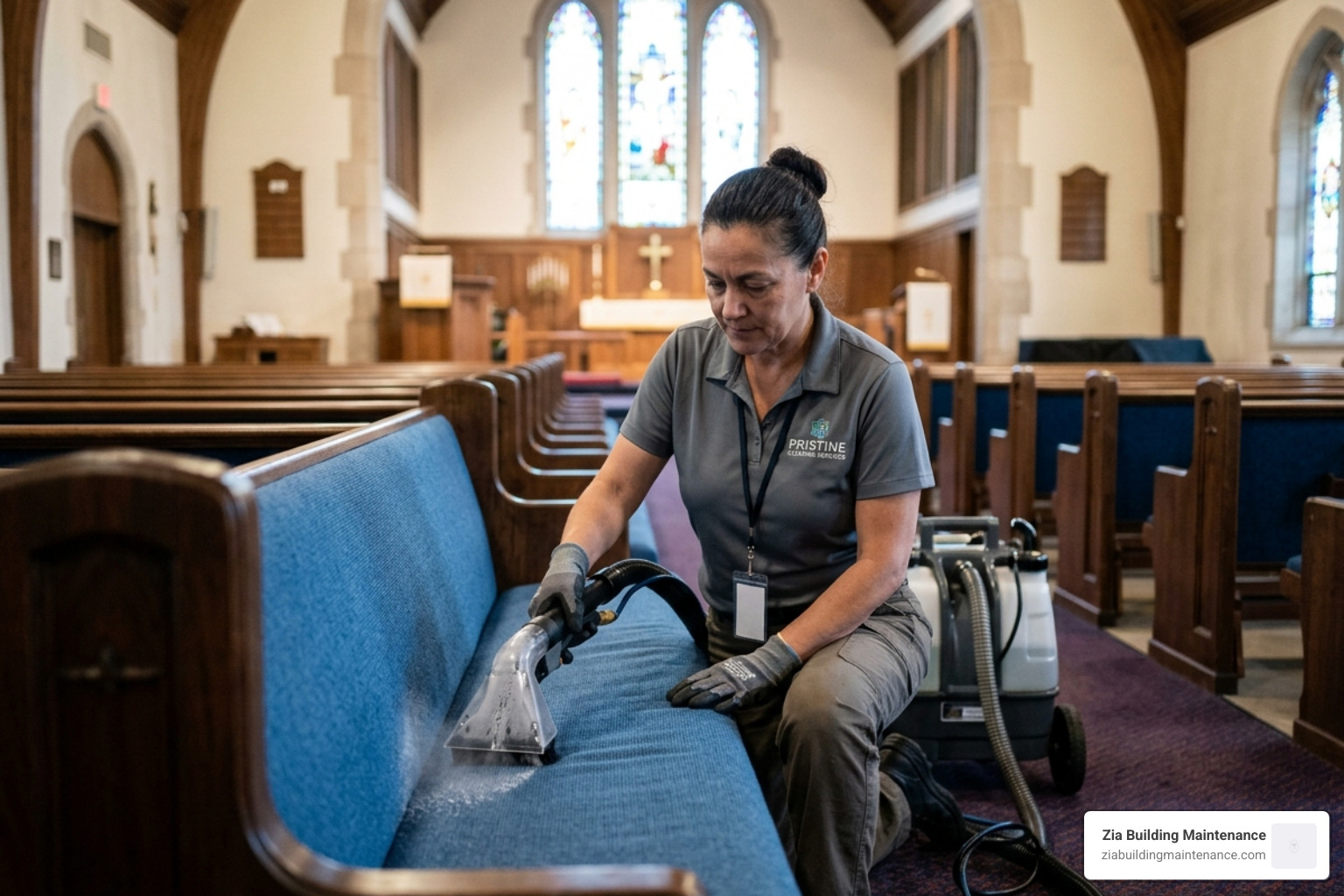
Professional cleaners bring equipment that a standard vacuum or hand-spray bottle simply can’t match. At Zia Building Maintenance, we use industrial-grade hot water extraction (HWE). This process injects heated cleaning solution deep into the fibers and then immediately sucks it back out with high-powered vacuum motors, taking the dirt, allergens, and bacteria with it. For more on how we approach these specialized tasks, see our guide on discovering top-tier church cleaning.
Professional Church Pew Upholstery Cleaning Costs
Pricing for church pew upholstery cleaning is typically calculated in one of two ways:
- Linear Foot: This is common for long, continuous pews. Rates usually range from $1.00 to $1.50 per linear foot.
- Per Unit: For individual chairs or removable cushions, prices may be set per piece (e.g., $15-$45 per cushion depending on size and material).
Factors that affect your quote include the type of fabric (S-coded fabrics require more expensive solvents), the level of soiling, and the total volume of seating. Many professionals have a “minimum trip charge,” so it’s often more economical to have all your upholstery—including office chairs and nursery rugs—cleaned at the same time.
Benefits of Professional Steam Cleaning
The primary benefit of professional steam cleaning is the heat. By reaching temperatures of 160 degrees or higher, we can achieve 99.9% disinfection without using harsh, damaging chemicals. This high heat also helps break down stubborn body oils that standard detergents can’t touch.
Furthermore, professional equipment provides superior moisture recovery. One of the biggest risks of DIY cleaning is leaving the cushions too wet, which can lead to mold or mildew growth inside the foam. Our high-powered extractors ensure pews are dry and ready for service in a fraction of the time. Learn more about our commercial carpet and upholstery cleaning capabilities.
Frequently Asked Questions about Pew Cleaning
How often should church pews be professionally cleaned?
For most active congregations in Albuquerque, we recommend a professional deep cleaning once a year. However, high-traffic areas like the foyer or pews used for daily services may benefit from bi-annual cleaning. Monthly vacuuming and spot-cleaning should be handled by your regular janitorial staff or volunteers.
Can I use household bleach to disinfect pew cushions?
No. We strongly advise against using chlorine bleach on church upholstery. It can cause permanent discoloration, weaken the fabric fibers, and will almost certainly void any manufacturer warranties. Use oxygen-based bleaches or fabric-specific sanitizers instead.
How long does it take for pew cushions to dry after cleaning?
With professional hot water extraction, pews are typically dry within 4 to 6 hours. If you are cleaning them yourself with a “wet” method, it can take 12 to 24 hours. Always ensure you have good airflow (turn on ceiling fans and AC) to speed up the process.
Conclusion
A clean sanctuary is a powerful testimony to the care and respect a congregation has for its house of worship and its members. From the historic chapels in Bernalillo to the modern worship centers in Rio Rancho, church pew upholstery cleaning plays a vital role in maintaining a healthy, welcoming environment.
At Zia Building Maintenance, we take pride in being a family-owned, New Mexico-grown business. Since 1989, we’ve been helping local organizations keep their spaces professional and pristine. We understand that church pews aren’t just furniture—they are the places where your community gathers for life’s most important moments.
If your sanctuary is ready for a professional touch, we are here to help. Our team provides the dependable service and attention to detail that your facility deserves.